*

“Ukrainian singer Gaitana won the hearts of the judges in her bid to represent her country in the Eurovision Song Contest this year. However, the 32-year-old, who was born in Kiev to a Congolese father and a Ukrainian mother has scored, “nul points” from a politician who has said she is not representative of Ukraine because of the colour of her skin.” > Story & video (c) euronews, 2012
.
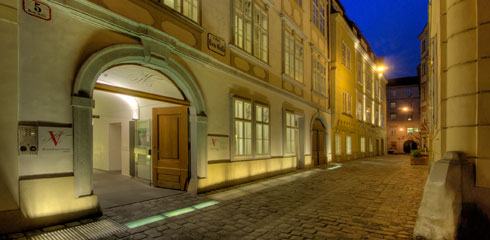
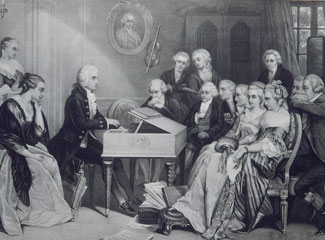
“Wolfgang Amadeus Mozart, most probably Austria’s most famous composer ever, is famous all over the world. Equally well-known is the fact that he often experienced financial difficulties. It would be incorrect, however, to assume that his debts were solely the result of his extravagant lifestyle. The temporary exhibition ‘Between Fear and Hope – Mozart’s rise and fall in Viennese society’ in the historic Mozarthaus in the first district shows how his career was not all a bed of roses.”
>article (c) wieninternational.at, 2012
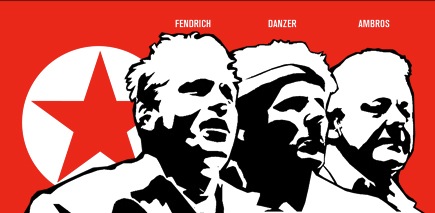
“Recent political and social developments in Austria have been widely portrayed in simplistically metonymic terms, with controversial figures such as Waldheim and Haider being perceived to epitomise Austrian society as a whole.” In his paper, Christian Karner analyses “the discursive/lyrical content of some of the songs by STS and Austria 3, two of the most successful bands within the genre of Austrian popular music. Approaching these two case studies from the theoretical perspectives of discourse analysis and cognitive anthropology, he tries to show that ‘Austro-Pop’ has – at important junctures in recent Austrian history – served as a tool of ideological resistance and created sites of social critique and cultural introspection.” (…) I have to admit: I am not really sure about this…
Punk playing (with) stereotypes on the region & the New World order
This is the Balkans here,
Fragrant flowers,
Totally incomprehensible to the whole world…
“When you think of rock n’ roll, Franz Liszt might not be the first name that comes to mind. But the classical pianist, born 200 years ago today, was in many ways the first rock star of all time.” Article (c) NPR, 2011
On 16 – 17 June the Royal Historical Society (RHS) Symposium Edges of Europe: Frontiers in Context was held at Lancaster University.
The Plenary Lecture entitled Acoustic Postcards from the Edges of Europe was given by Professor Michael Beckerman, Head of Music at New York University.
His research interests include Czech and Eastern European music, Janacek, Dvorak, Martinu, nationalism, Gypsies, Mozart, Brahms, Gilbert and Sullivan, Schubert, and film music.
He received the Janacek Medal from the Czech Republic and is a Laureate of the Czech Music Council. He lectures widely and writes regularly for the New York Times.
Here you can view a video of his talk.
Culture is a battle ground for significance and distinction… a never ending story.
Example: the Serbo-Canadian rap group Illuminati X (FKA Street Team Balkan Beasts) which made itself a name for its nationalistic lyrics…
Self-victimization and comparative suffering serve as a legitimizing strategy –
for more violence?