Collateral Roadkill?
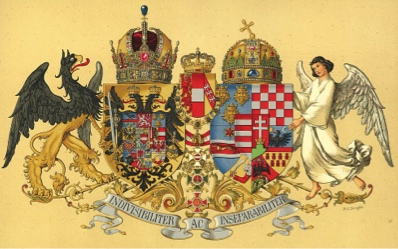
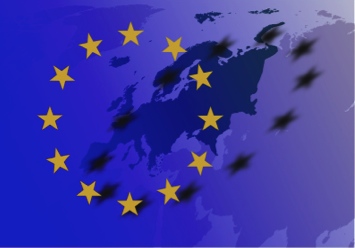
THE DEATH OF THE ‘MITTELEUROPA’ CONCEPT ON THE WAY TO SARAJEVO AND BRUSSELS – AND BEYOND. A Lecture Manuscript.
There are quite a few conflicting narratives of what Central Europe is or what it could be. As a motto of sorts, I will use a quote from The Bremen Case, one of the best ten novels I have read in the last 20 years. Here the author, the Serbian journalist, writer and diplomat Dragan Velikić (1953- ), conjures the proverbial hybridity of the region, which he unnostagically shows to be a battlefield as well. Central Europe is called
“a swamp of pedigrees, coats of arms and flags, (…) strange combinations of first and last names in the phone directories — this amorphous territory where wars are waged because of accents and borders, where epics are forged (…)”–
and where epics and pasts are faked, as I should like to add.
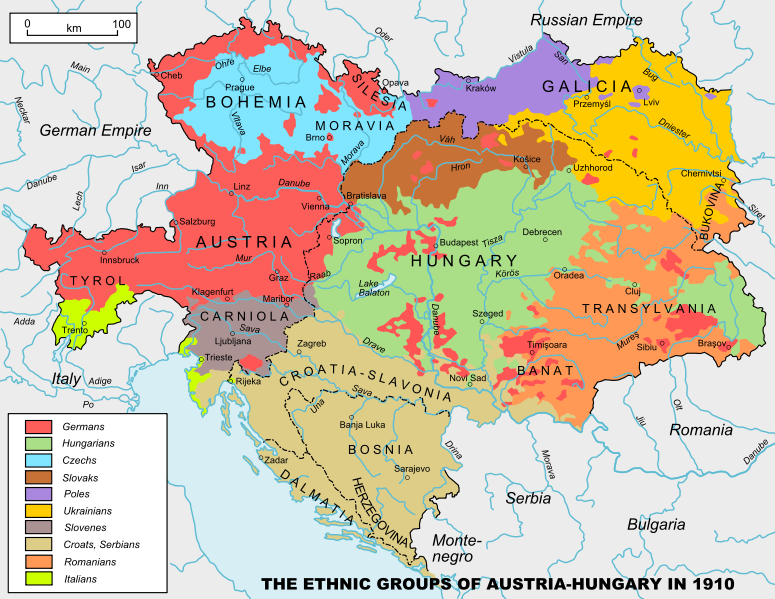
One major narrative and discursive front line behind any notion of Central Europe seems to be the scholarly and political assessment of the Habsburg past which often just reproduces the two conflicting narratives of the era in question: on the one hand, the nationalist story that the Habsburg Monarchy was a Völkerkerker, a „Prison of Peoples“, and, on the other hand, the unionist credo which – along the lines of what Claudio Magris calls the ‘Habsburg Myth’ – nostalgically sees the Austria-Hungary as a multicultural predecessor, if not a role model for the European Union. But there should be a third way of narrating the Habsburg past, as the informal research network Kakanien Revisited which was set up by Wolfgang Müller-Funk, myself and other researchers more than 10 years ago, tried to prove, a trajectory that is able to bypass the fallacies of the former two. Facing the lack of a better fitting term, Wolfgang Müller-Funk and I called it a ‘Post-colonial’ approach to the Habsburg empire which critically tried to deconstruct the two mentioned narratives, having learned its lessons from Edward Said, Homi Bhabha, and other theorists of Postcolonialism.
As I shall try to show now, most discourses on Central Europe as a region are also informed by, if not translations of the pro- and anti-Habsburg narratives outlined before. What many, if not most of them, have in common is that they were formulated post festum, thus retrospectively, or at least from an imminent crisis or virtual aftermath, which I am tempted to call their little apocalyptic undertone.
But let us begin with a first claim: Central Europe as a geographic entity is a floating signifier. As Jörg Brechtefeld notices in 1996,
„the German term Mitteleuropa (for ‘Central Europe’) never has been merely a geographical term; it is also a political one, much as Europe, East and West, are terms that political scientists employ as synonyms for political ideas or concepts. Traditionally, Mitteleuropa has been that part of Europa between East and West. As profane as this may sound, this is probably the most precise definition of Mitteleuropa available.“
However, what can be learned from Brechtefeld’s quote is that any discursive construction of Central Europe is not only a floating signifier; it also creates a liminal area between the East and the West, and the North and the South of the continent; a contact zone in between, as it were, which has brought Otto Forst di Bataglia (1889-1965) to call this entity “Zwischeneuropa“, In-between-Europe. And if you use the Google image search for finding maps of the region, you will notice that almost no map is like the other, depending on which countries are counted in and which ones left out when it comes to Central Europe.
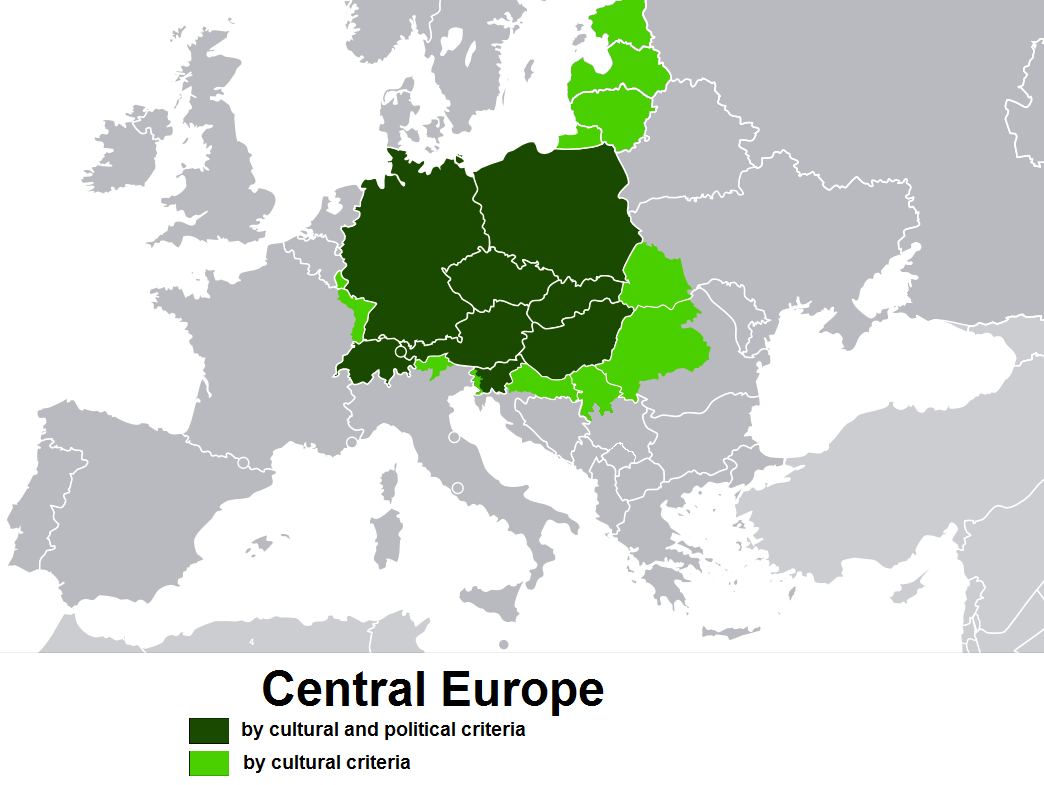
What connects and constitutes any cultural construction of Central Europe is this inbetweenness, this existence on a threshold, and if you don’t like the anthropological term ‘liminality’ (which I like, because it is all about border and boundaries and their transgression), then you can replace it by the historical concept of ‘borderlands’ or by the heuristic metaphor of a manifold overlap. According to the renowned Bulgarian American scholar Maria Todorova, the region can be seen “as the complex interplay of numerous historical periods, traditions and legacies”. Following this approach, the following factors can be mentioned that constitute Central Europe as the crossroads of the continent:
- The area in question has been the intersection where all major religions and the linguistic communities of Europe, the Germanic, Romance and Slavic plus several smaller languages, meet, where they are historically confronted with each other but also form hybrid spaces at times.
- Another connector is the region’s post-imperial situation, which is post-totalitarian as well, and in many cases Post-communist. Central Europe consists basically of the aftermath, i.e. the territories and histories of the European successor states of four bygone multi-ethnic empires, Germany, Austria-Hungary, the Russian Empire of the Tsars (and later, the Soviet Union), and the Ottoman Empire. Thus, Central Europe has been exposed to almost never-ending political, economic, societal and cultural changes in the last 100 years, much more than the West; it has been the venue of major wars, ‘ethnic cleansing’ and genocides, among which the Shoa, aka. the Holocaust is the most notorious, but not the only one.
- So, as a consequence of its imperial past, Central Europe can be characterized by the experience of belated nation building and multiple transition, or transformation, respectively; so to say a laboratory of Europe´s Modernity, or die “Versuchsstation des Weltuntergangs“, the lab of the apocalypse, as the Viennese author Karl Kraus (1874-1936) allegedly put it. The question has always been if this creates a specific Central European path through history, a “Sonderweg“, as the French scholar Jacques Le Rider (1954- )puts it.
However, I am not interested in conducting area studies here. I would rather like to take advantage of an observation by German Scholar Walter Schmitz who states that Central Europe emerges “at the intersection of several discourses that produce meaning”. I also see Central Europe itself as a sort of discursive construction of a certain regional identity, which I shall call Mitteleuropa to make a distinction between geography (which claims to be neutral) and geo-politics. Scrutiny reveals though that there is no such thing as objective geography – so as my examples hopefully show, geopolitical concepts and maps mutually reinforce each other.
*
I would like to claim now that the historical construction of Mitteleuropa, which emerges in the 19th century and is gradually abolished as a concept with the EU accession of the Central European countries in 1995 and 2004, receives its philosophical tension and lines of development from conflicting narratives that are underlying each version of the discourse. As will be shown, some of these narratives are driven by imperial ambition, others by post-imperial melancholy (or stress disorder?). I will now try to filter out four of those narratives and their leitmotifs to show how the respective foregrounding of them creates a specific version of the Mitteleuropa discourse. There might be more than four narratives, but, for time constraints, I will concentrate on some essentials here and refer you to J. Le Rider´s book on the subject matter for more details. (A smaller competitor of Mitteleuropa, btw., is the discourse of Stredni Evropa, a term used by the Viennese professor and later Czech president Tomáš Masaryk (1850-1937), also known as East-Central Europe which only denotes the small, non-German speaking countries in the middle of the continent, wherever this might be. )
Anyway, what all these narratives have in common is specific tropes or Topoi. Many of those narratives, for instance, start up with describing the psychological and political situation of the small Central European nations as being “between a rock and a hard place,” that is Germany and Russia. They secondly formulate the necessity or historical given-ness of a sort of community across religious and ethno-linguistic borders, which creates brackets between those small countries. And they thirdly create a sort of positive or negative genealogy with regard to the Habsburg Empire.
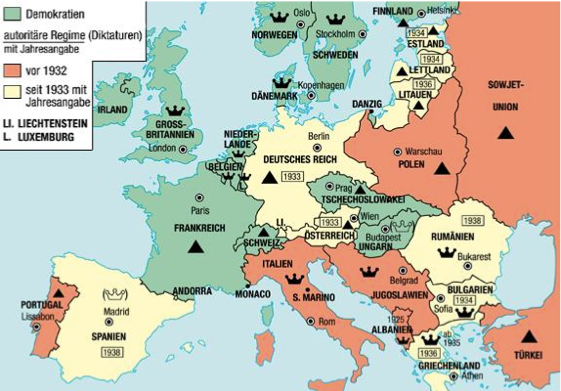
I will now let these narratives briefly parade in front of your eyes; as a sort of basso continuo, I have also included some maps and photos, which allude to major historical developments of the eras in reaction to which these narratives were formulated. However, I cannot discuss those historical backdrops in depth, but will use the illustrations as a sort of visual reminder.
So let’s come to Narrative #1 with the leitmotif Protection: The Czech historian and politican František Palacký (1798-1876) is regarded to be the founding father of a political movement called Austroslavism in the years around 1848, which used an early version of a Mitteleuropa discourse to support its ideology. Very famous are Palacký´s words that „if the Austrian State had not existed for ages, it would have been in the interests of Europe and indeed of humanity to (…) create it as soon as possible.” This passage stems from a letter to the German revolutionary Parliament in Frankfurt in 1848, when the latter had tried to win over the Czechs for the German national project. Palacký however, was sceptical about his Czech compatriots joining a newly created greater German Empire. In contrast, he envisages a strong and independent Austrian empire which he envisages as a federation of the southern German-speakers and the smaller ethno-linguistic groups of the region particularly vis-à-vis Russia, allowing for the retention of their individual rights and cultures.
However, in the long run of the long 19th century, Austroslavism became outdated, since the Slavic masses favoured a less moderate version of nationalism and identity building, with the well-known unhappy ending in 1918. After this breakup of the Austro-Hungarian empire, the rubble of Palacký’s thoughts, mixed with other ideas, lies at the core of the retrospective Habsburg Myth, as the Triestine scholar Magris calls it, a sort of grief and dream work of an alleged better past, which finds its exemplary presentation in the works of the German-speaking Jewish writer and Austrian exile from Western Ukraine, Joseph Roth (1894-1939), for instance, his novels Radetzymarch and Kapuzinergruft.
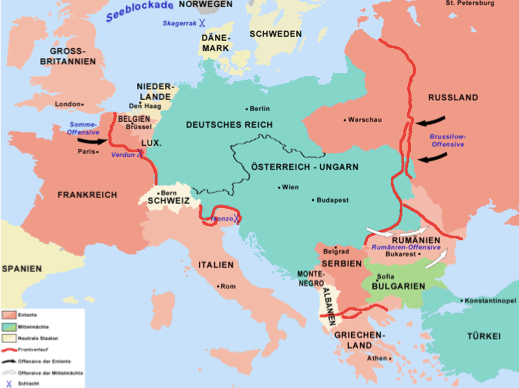
Shortly before the collapse of the old empires, the Protestant clergyman and politician Friedrich Naumann (1860-1919) in Germany came up with the most problematic version of a Mitteleuropa discourse which has tainted the whole idea until today: Narrative #2 on my list. Naumann´s thinking, promoted in his book entitled Mitteleuropa from 1915, can be called liberal imperialism and is influenced by his friend, the sociologist Max Weber. It departs from the idea of an imminent German and Austrian victory in WW1 and plans its aftermath. Out of the momentum of the so-far successful military alliances between Germany, Austria-Hungary including the smaller non-Germanic ethnic groups living in the region, a future Central Europe should be created which is politically and economically integrated between “the Vistula and the Vosges Mountains, and what extends from Western Ukraine to Lake Constance” – and which serves as a buffer zone vis-à-vis Russia. To be found between the lines of this version of Mitteleuropa is thus very evidently a sort of German backyard politics, comparable to the interference of the United States in Latin American politics; the Austrian allies at the time were clearly not amused about the insinuated gradual dissolution of the Habsburg Monarchy into this new entity under German leadership. However, Naumann’s roadmap to a German-dominated Central Europe is not the only, but only the most famous Imperialist German concept around World War One; it was later used as a blueprint for Nazi geopolitics in the region.
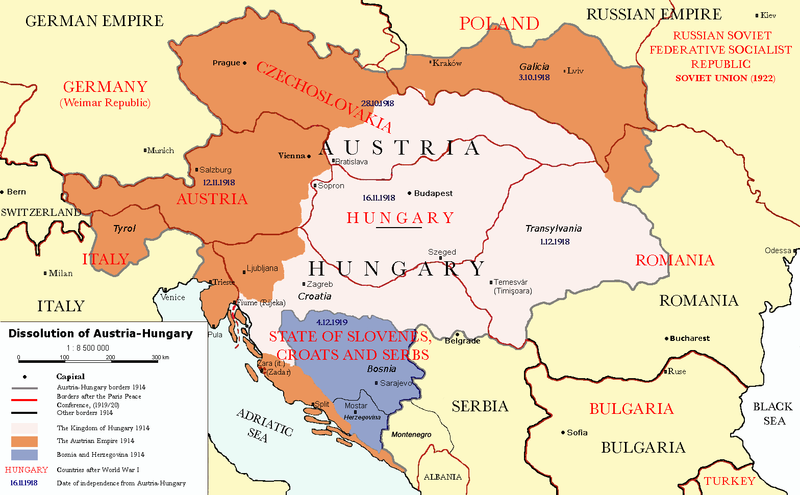
I should not omit that particularly in the interbellum period, there was a revival of the first Mitteleuropa narrative particularly among Habsburg nostalgics, along the lines I have already sketched, mentioning the name of the Austrian Jewish writer Joseph Roth. All of these thoughts, however, were able to bridge the gap the disppearance of the Habsburg cohesion had left only as a cultural idea, but not in the political realm. In a parallel action, as it were, the Paneuropa-Union was founded in the 1920 by the Bohemian-born aristocrat Richard von Coudenhove-Kalergi (1894-1972) along with Thomas Mann, Otto von Habsburg and other protagonists of a rather conservative orientation, giving a voice to the idea of a united Europe. The historical decisions were taken elsewhere, leading to authoritarian rule and dictatorship not only in many countries of the Central Europe, but also throughout the continent.
Mitteleuropa Narrative #3 is probably the most acceptable, since it provides a sceptical analysis rather than a roadmap; on the other hand, it mainly provides a critical template without too many positive directions, and thus deconstructs itself quickly. I am referring here to István Bibó (1911-79) who was a historian working as a librarian at the university of Budpest. One of his major works is The Misery of the Small East European States (1946). It tells the story of Central Europe as a tale of disaster insofar as it shows and deplores the peculiar consequences of belated national development, warns of ardent nationalisms leading into future catastrophes and investigates ways of reconciliation in the region (which must have sounded quite utopian in Cold War Europe). On the other hand, Bibó rings the warning bells about the effects of supranational states as well. He is thus one of the founding fathers of a critical, non-nostalgic, non-nationalist and non-imperialist Central European narrative in Postwar Europe.
What’s seems to be significant about narratives on Central Europe that they are linked with particular situations in late Empires or their aftermath, or situations of where central European felt overpowered by historical developments which had led to totalitarian rule, the Second World War and its genocides. It doesn’t come as a surprise then that the new heyday of Mitteleuropa discourses were the 1980s when the tensions of the Cold War between the super powers was relaxing and new cracks in the Eastern Bloc became visible again.
The discourse of Mitteleuropa was revived (Narrative #4) by a group of Central European writers and intellectuals, most of whom were friends or at least acquaintances, the Czech exile Milan Kundera (1929- ), the Hungarian György Konrád (1933-) , the Yugoslav Danilo Kiš (1935-89), the Polish writer Czesław Miłosz (1911-2004), who were supported by a group of liberal conservative politicians around the later Austrian vice-chancellor Erhard Busek (1941- ), the Viennese literary critic Wolfgang Kraus (1924-98) and other intellectuals in the „Free West“.
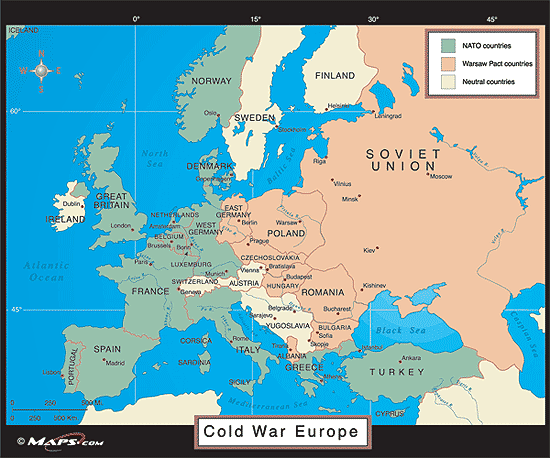
The probably most famous but also most problematic document in this context is Milan Kunderas L’Europe Kidnappé / The Tragedy of Central Europe. In this literary essay, Kundera reiterates images of an alleged old division of Europe between Rome (the West) and Byzantium (the East). It is his endeavour to move the smaller member states of the Warsaw pact, or the Eastern Bloc, as it was called as well, back tot he West, and in order to achieve this, paradoxically, he re-invents the intermediary zone of Central Europe. Kundera is also eager to create a sharp contrast between the almost „Asian“ Russians and the Central Europeans, for instance, by disengaging from the notion of a „Slavic soul“, following teh Polish American writer Joseph Conrad (1847-1924) in this respect). It’s noteworthy here that particularly Kundera’s black-painting of Russia and its culture is at the brink of racism and has been moderated in later print versions of the text obviously.
However, Kundera’s essay manoeuvres very consciously in the footsteps of Palacký. It rediscovers – or re-invents- a common tradition for the region and thus not surprisingly conjures the spectre of the Habsburg Empire as a point of departure:
“The Austrians had the great opportunity of making Central Europe into a strong, unified state. But the Austrians, alas, were divided between an arrogant Pan-German nationalism and their own central European mission.“
And then Kundera says about the Habsburg Monarchy: “…in spite of its inadequacies, it was irreplaceable.”
This rediscovery – or re-invention of a shared tradition – becomes a device to short-circuit the East West Divide, or the frontlines of the cold war in the region, respectively. This narrative is Anti-Communist, in a version that is meant to appeal to dissident lefties as well as to conservatives and liberals. Between the lines, you’ll find the Habsburg myth, at least in a Palackýian version, as hidden narrative, as well as in the corresponding versions of this new Mitteleuropa narrative on the other side of the border where it is formulated as a sign of -imperial hope that Austria and Hungary one day could regain their lost significance. (And important function of most Mitteleuropa narratives after 1918 is their post-imperial melancholy and mourning for the lost grandeur.) Anyway, this undead version of the Habsburg myth in a postmodern version, that tried to bridge the gap the Iron Curtain had created, proved to be pretty powerful as a figure of thought, at least as a placeholder for new things to come.
Around and after the changes of 1989 there have been many attempts to forge regional bodies, such as the Pentagonale or the Alpen-Adria conference, which have not been very successful except on a microregional level. German and Austrian investors swarmed into the region in the 1990s, leaving a bad neo-colonial taste behind in many mouths. I remember a toilet graffito in Budapest in the 1993, asking: “Hungarian, why are you sad? Becoz Austrian and American gangsters are robbing my country.”
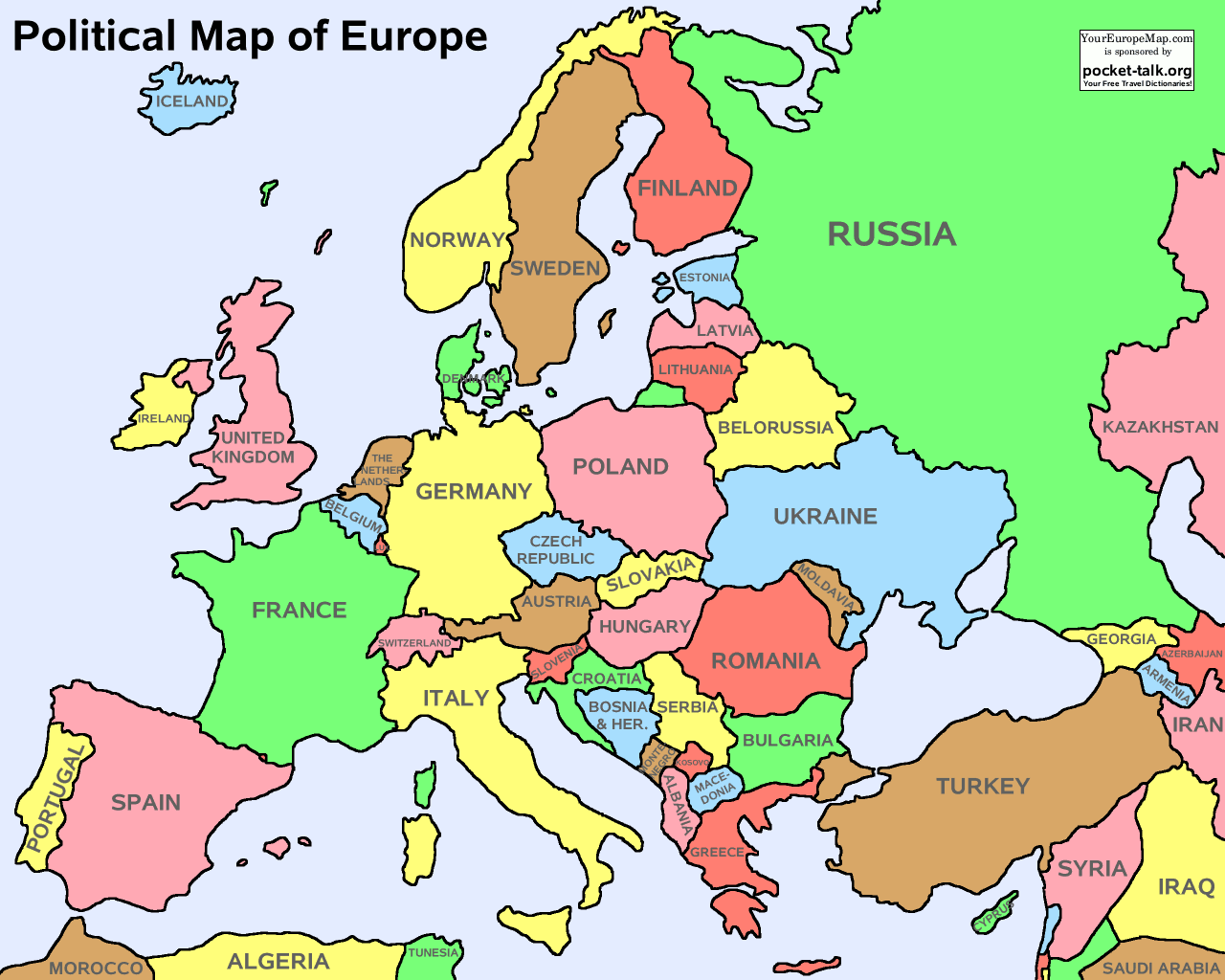
Now it is time for a first wrapping-up session. As we have seen, Mitteleuropa approached as a discourse can be seen as a bundle of conflicting narrative elements moderated by every version of the discourse. Every narrative of Mitteleuropa through intertexuality refers to every other narrative virtually. They exist in their opposition to each other, in their différance, to use Jacques Derrida’s term. Their ingredients are pretty much the same even between Palacký and Naumann – although the focus, or the protagonist respectively, is different: Bohemia and Austria vs Germany.
But these narratives also share a few more traits: they mostly work retrospectively insofar as after world war one, they start telling a Verfallsgeschichte, the history of gradual decay of the Habsburg empire, and its multiethnic heritage. However, they are utopian at the same time, as they repeat the mantra of the alleged positive potential to be found in this declining empire, and very often they are driven by the will to power, that is, the endeavour to rule or at least to co-rule. It is interesting to investigate what made these narratives die out.
*
The two cemeteries, where the illusions of a renewed and shared Mitteleuropa were buried eventually, go by the names of Sarajevo and Brussels. In other words, the events that terminated any further hopes of a revival of Central Europe as a political entity are basically two:
Number one is the EU accession of most Central European countries in 1995, and in 2004. As Maria Todorova (1949- ) writes in her article on the region,
“Central Europe’s emancipatory ideology, over which much scholarly ink has been spilled, became after 1989 a device entitling its participants to a share of privileges: accession to the NATO and the front seats for the EU. While the final historical verdict may be that this strategy was a ‘politically successful representation’ with qualified achievements for some, the unintended consequence is that at present ‘Central Europe’ as an idea is dead.”
This does not need to bad development necessarily. However, another important place where Mitteleuropa died and was buried, were the gory Yugoslav Wars of Succession in the 1990s. The mass murder committed on more than 8,000 male Muslims in Srebrenica in 1995 and the beleaguered city of Sarajevo have become the epitome for this horrifying outburst of violence and the comeback of genocide to Europe which nobody had expected again after the end of two World Wars, the Holocaust and the Cold War. But maybe the killing in ex-Yugoslavia happened exactly because of that: as a uncontrolled restaging of a massive trauma that had not been worked through in the Balkan region after 1945 (but was it everywhere else in Europe?).
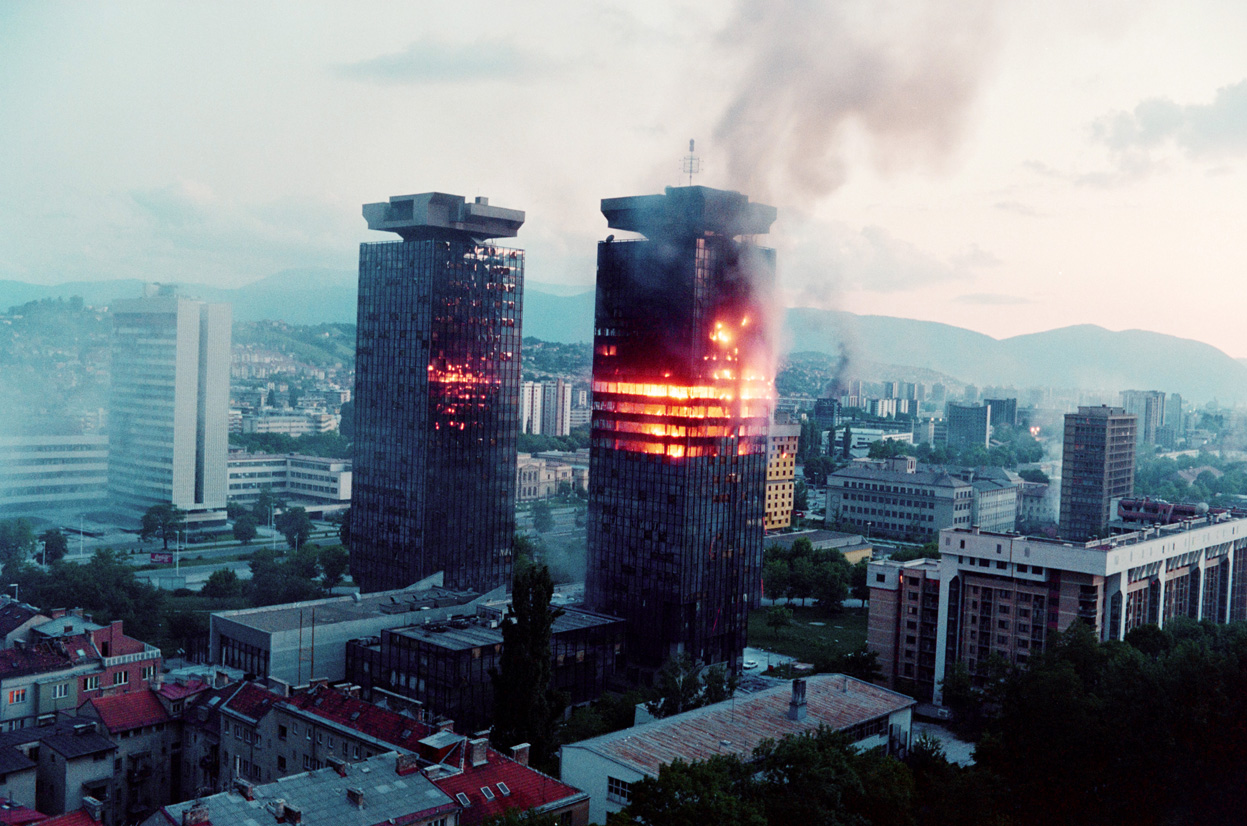
Thus Sarajevo became the site of the longest-lasting siege of a capital city in modern European history, with more than 1400 days between 1992 and 1995, in which more than 10,000 people, most oft them civilians, including over a 1000 children, were killed by enemy fire, snipers, artillery, but also disease and famine. Particularly this Bosnian war left Europe in the position of a helpless bystander, hypnotized and paralyzed by the atrocities which it was unable to stop, because it was still torn in the positions of World War One, and it took particularly the British and the French years to give up their mental alliance with the Serbian aggressor in ex-Yugoslavia.
Thus, after Central Europe, in its South Eastern outskirts, had had become a „inhabited ruin“ – to borrow the title of a new edited volume by Derek Sayer and Dariusz Gafijczuk -, any concept of Mitteleuropa had to be declared clinically dead eventually, a lip service meant for literary readings and nostalgic old boys’ networks.
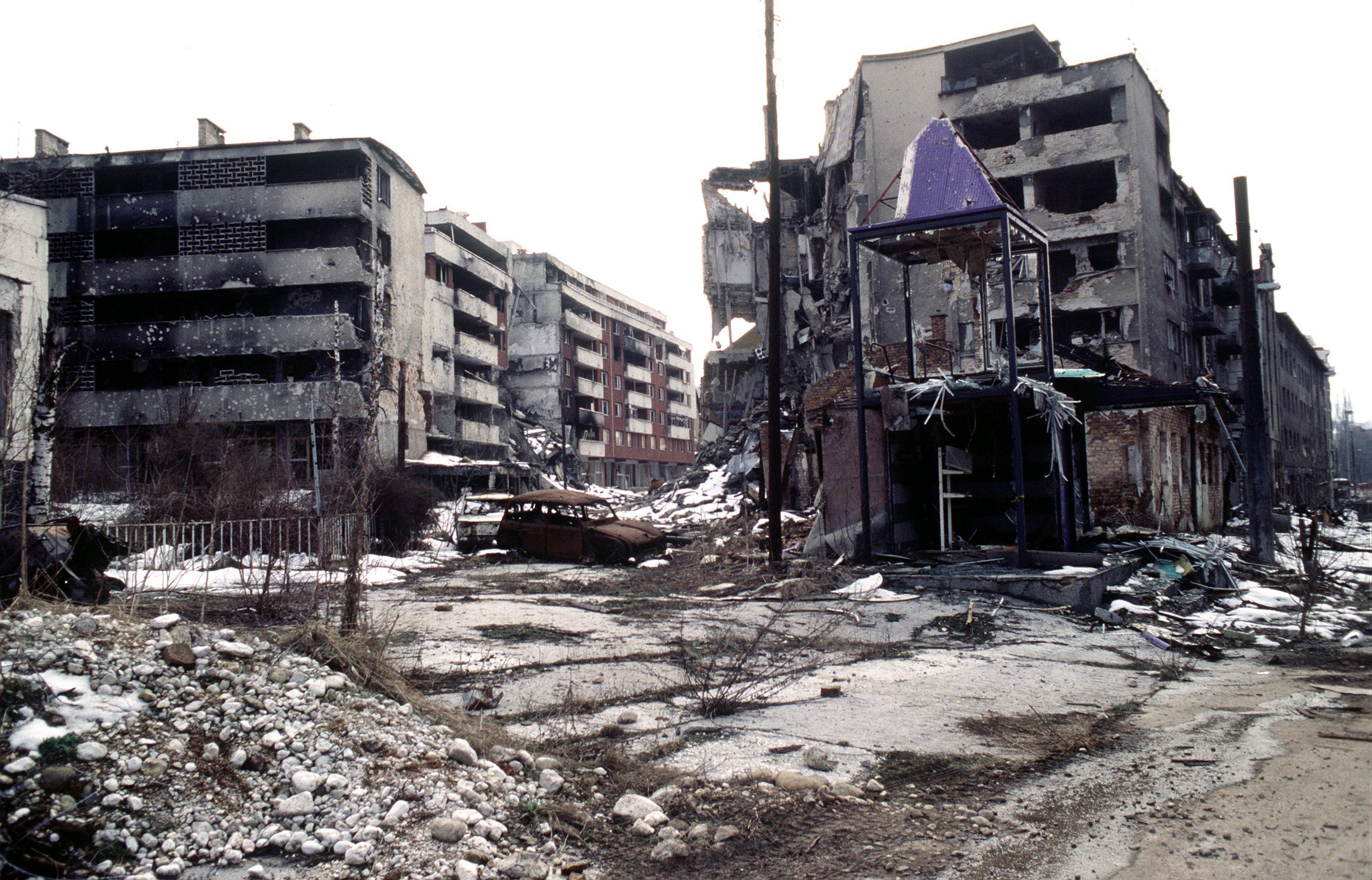
As a sort of emblem I am using here architectural sketches by the American visionary artist Lebbeus Woods (1940-2012) for the reconstruction of the cities of postwar Sarajevo, Havana (after the suffocating American trade embargo against Cuban communism) and San Francisco after the Loma Prieta earthquake (1989). However, Woods did not intend to tear down the remnants of Sarajevo houses destroyed in the siege. His “Radical Reconstruction” (as his book on the subject matter is entitled) would repair parts of the buildings’ structure, but leave a taste behind of what it looked like as a ruin, and then seal the transition between old and modern parts of the building by a structure reminiscent of a high-tech a suture.
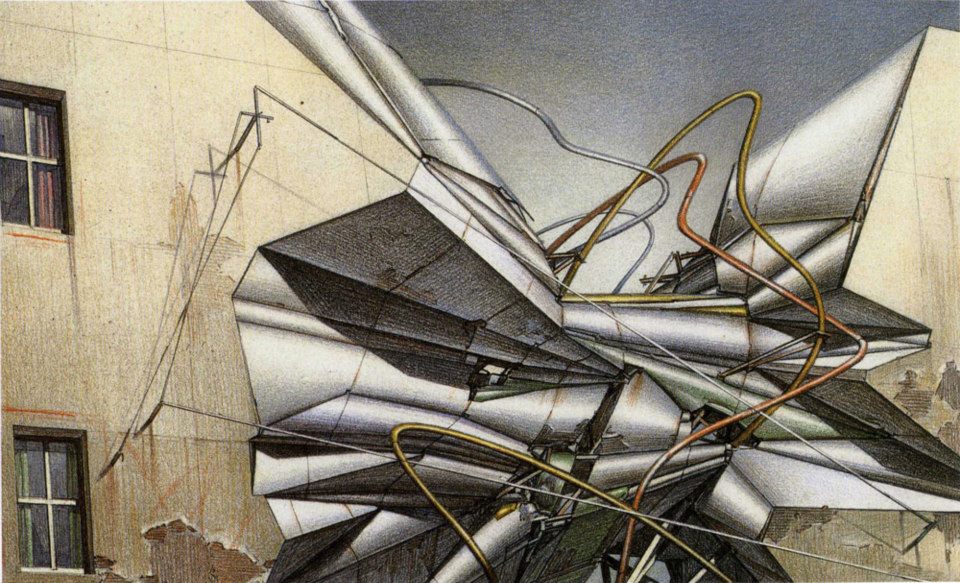
And indeed, Woods meant his sketches to be an architecture that heals wounds, but still displays scars, buildings that reconcile, but still keep people aware of the traumatic past at the same time. An impossible task, like squaring the circle, and it is needless to say that the politicians and inhabitants of Sarajevo did not go for this project. The ruin, as the German sociologist Georg Simmel (1858-1918) would say in his famous essay one hundred years ago, is “die Gegenwartsform der Vergangenheit”, the ‘present tense of the past,’ as it were. Accordingly, in Woods´s architecture of the revamped ruin the history of Central Europe is symbolized, recalled, welded into sutures and deconstructed at the same time, as it is in the strange and half-forgotten EU protectorates of Bosnia-Herzegovina and Kosovo.
The later two „countries“ are also markers of the endangered multi-ethnic character of the region after the violent nation building processes of the last decades. To me Bosnia and Kosovo appear as the last bleeding body parts of the corpse Yugoslavia, half-dead or undead, put into an emergency care ward of the European Community Hospital, with an uncertain future. Their cases are similar to the national draining of other multi-ethnic regions of Europe, such as Transylvania in Romania (which happened for different reasons, but nevertheless).
In an article which he wrote for and about beleaguered Sarajevo in March 1993, the French philosopher Jean-Luc Nancy (1940- ) sketches a theory of identity and hybridity under the the “Eulogy of the Melée” which could be inspiring for our Central European investigation. Here Nancy celebrates the principle of the Melée or “melange”, to use the well-known Austrian term for a coffee mix, and he deplores its disappearance in the Bosnian war. His piece of philosophy and cultural theory points at the danger that lies in naming the ingredients of the mélange: “To essentialize the mélange is to have already dissolved it, melt it down into something other than itself.” It’s pretty evident here to see the tension between the mixture and the essential ingredients here as a symbolism for multi-ethnicity and its breakdown in nationalisms of all kinds.
This probably is the strongest argument to diagnose the disappearance of the old Central Europe / Mitteleuropa whose mixtures have been taken apart and dissolved. It’s not only about the old multi-ethnicity within territories per se which is regarded as an obstacle to having clean “nation states”. The other side of the national medal is the disappearance of the minority groups that floated between and worked as glue across political entities: I am referring here to the Holocaust, killing many of the Central and East European Jews or forced them into emigration, and the expulsion of the ethnic Germans in 1945ff. from the region as a retaliation measure for the crimes committed under Nazi occupation. The third transnational group that still exists, the Sinti & Romani, a.k.a. gypsies, cannot be regarded as something that connects the region really, but rather as the scape-goat focus of all hatred and racism left there.
We have seen the final victory of the nation state as a prevailing political format for organizing countries, societies and their relations. This development will not be overcome by any weak Mitteleuropa discourse which, behind its false pathos of ‘shared past’ and a ‘common belonging’ still has a hidden agenda of hegemony and dependence, but rather by Turbo-capitalism – to put it cynically. On the other hand, globalization brings new migration with it, which is not united through a common feeling of a shared past, but rather of a shared provisional present. As Nancy states in his essay Eulogy of the Melée:
“The mélange, therefore, is not. It happens; it takes places. There is a mêlée, crisscrossing, weaving, exchange, sharing, and its never a single thing, nor is it never the same. On the one hand, the mélange is an ‘it happens’ rather than an ‘it is: displacements, chances, migrations, clinamens, meetings, luck, and risks.”
The conclusion that could be drawn out of Nancy’s stimulating thoughts about identity and hybridity is that globalization and migration do not create a danger, but rather a potential for the future. In lieu of the old Mitteleuropa discourse, which constructs a shared, (post-)imperial past, the current experience of migrants in Europe could create a new cohesion throughout the continent. The experience of integration into meta-motherlands they have moved into along with the memories of their places of origin could create a shared present and a future together rather than the past of the 20th century.
I am coming to a conclusion now: In the lights of the events of the changes of 1989 and the following years leading to the EU membership of many Central and South East European states in 2004, I thus would like to state that Mitteleuropa has come to a closure. This is not a bad thing necessarily, since that discourse in question was not capable of providing common grounds for action to prevent extreme nationalisms and genocide from happening. Moreover, as has been stated, it has been a post-imperial discourse of nostalgia and the mourning about lost significance of the former hegemonic centers, using the disguise of equity. The beliefs of the late Otto von Habsburg and his circles in Munich, Vienna and Brussels that the history of the Habsburg Monarchy and the rise of “Mitteleuropa” could provide a role model for a future European Union should thus be renounced. If the European Union is to be the new Habsburg Monarchy, even with its utopian potentials, then we are really doomed. The narratives of “Central Europe will stay, but only as the subject and tool of historical analysis and not as a road map for the future. This is not about neglecting and repressing our shared pasts: it´s rather about coming to terms with it and eventually overcoming it.
If you remember the initial motto by Dragan Velikić: Central Europe is not only the Habsburg myth carrying the grandfatherly face of Emperor Franz Josef, but also a huge cemetery full of mass graves and suffering. In this respect especially Austrians need to learn their history lesson a bit better, that the Habsburg Monarchy was not a potential MULTI-KULTI paradise but the cradle of nationalisms and totalitarianisms of all kind, the prehistory of ethnic cleansing and genocide, and the Holocaust.
I thus agree with Maria Todorova, that as a macro region, Central Europe is dead: the European Union and particularly its new geographical entity Schengen–Land, however, have resurrected new micro-regional clusters transcending national borders culturally and/or economically, often on a historical basis, such as Silesia between Poland, Germany and the Czech Republic, the twin-cities of Vienna and Bratislava (aka. Pressburg and Pozsony) that are scheduled to grow together increasingly in terms of infrastructure, the border regions between Italy, Slovenia and Austria (the old Habsburg crownland of Krain/Carniola), or between Italy, Slovenia and Croatia (Istria), or the small-city cluster of Györ, Eisenstadt and Sopron between Austria and Hungary.
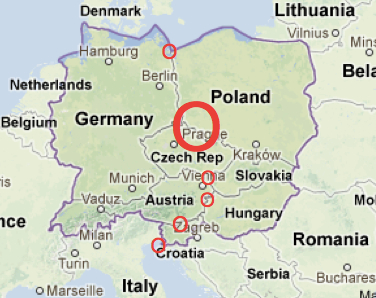
In order to conclude now, I would like to briefly go back to Brussels and the EU:
The new arrangement of interstate relations through the European union has fostered new confidence in the former socialist countries – for example if you look at the European politics of Poland – and new links. The European Union is meant to create new neighbourship “at the same political eye level”, as it were, i.e. a partnership based on political equality rather than on physical borders and post-imperial history, which always quotes a past of hegemony and domination between the lines. So who really needs Central Europe?
Nobody should be nobody´s satellite state ever again: in order to provide a vision here, but sound less freehandedly optimistic, let me state at the end of my talk that the new-found equality and neighbourship across the continent has been jeopardized again by the economic crisis which has created new hierarchies between creditors and debtors, between teacher’s pets and bad students in the Austerity Class of 2009. That’s why we need to sort out the financial crisis at any cost.
*
Text of a talk given within the EURO-VISIONS Lecture Series at the Long Room Hub Arts & Humanities Research Centre, Trinity College Dublin, on 15 May 2013
© Ruthner & Trinity Long Room Hub, 2013
 delirium clemens
2 June 2013 at 08:31
Just wish to say your article is as amazing. The clearness in your post is just nice and that
i could suppose you’re an expert in this subject. Fine along with your permission let me to snatch your RSS feed to stay updated with impending post. Thank you one million and please carry on the gratifying work.
19 July 2013 at 16:12
Hi there to all, it’s in fact a nice for me to pay a visit this web site, it includes useful Information.
30 July 2013 at 17:03
I like the helpful info you provide in your articles.
I’ll bookmark your weblog and check again here frequently. I am quite sure I’ll learn
a lot of new stuff right here! Good luck for the next!