On the Other Side
Alfred Kubin and his 1909 novel Die andere Seite
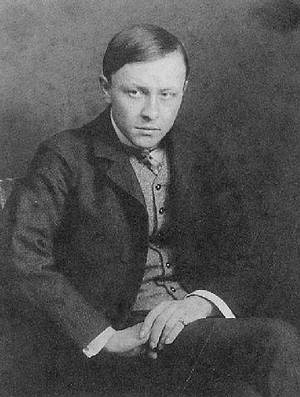
Biographic loss & the fantastic in art
Kubin, whose father was a land surveyor, was born in Leitmeritz (Litoměřice), Bohemia, in 1877. He spent his early days in Salzburg and Zell am See, Austria. In 1887 his mother died. From 1892-96 he was a photographer’s apprentice in Klagenfurt. Then he started studying Fine Arts in Munich in 1898 and dropped out again in 1899. However, Kubin remained in the Bavarian capital and joined the local art scene. His father died in 1908.
After seeing Max Klinger´s series of etchings entitled Paraphrase über den Fund eines Handschuhs (“Paraphrase on the Finding of a Glove“) in 1899, the young artist lived through a veritable creative frenzy, an “invasion of black and white visions” which lasted until 1903. He soon acquired a reputation for being a graphic artist and book illustrator specializing in uncanny, grotesque and allegorical subjects. “I am the organizer of the uncertain, hermaphroditic, shadowy, dream-like,” he wrote in a letter on 9 January 1908.
Numerous exhibitions followed. Kubin made thousands of drawings throughout his life, illustrated some 60 literary works (among them Poe, Dostoevsky, Nerval, and E.T.A. Hoffmann) and published several art books and portfolios of prints.
Splendid isolation in the Innviertel
In 1906 Kubin moved his residence to the village of Zwickledt in Upper Austria, near the river Inn, on the border to Bavaria. He stayed there until his death, together with the sister of the writer Oscar A.H. Schmitz, Hedwig Gründler, whom he married in 1904. However, his work was not only informed by this particular region, the Innviertel, but also by his love for the forests of the Böhmerwald – home to the legendary giant Rübezahl – and the Bayerischer Wald.
In 1909, with Wassily Kandinsky and others, Kubin was involved in founding the Munich-based Neue Künstlervereinigung (“New Artists’ Association”), the predecessor organization of the famous expressionist alliance Der Blaue Reiter (1911), and he took part in the first exhibition of the latter. From 1912 on, Kubin was employed by the satirical magazine Simplicissimus, until the periodical ceased to exist in 1944.
In 1931 Kubin designed the sets for Richard Billinger’s drama Rauhnacht for its world premiere at the Munich Chamber Theatre. Other friends and correspondents of the increasingly withdrawn artist were Fritz von Herzmanovsky-Orlando, Ernst Jünger, Hans Carossa and Hans Müller.
National Socialism and late works
In the era of National Socialism in Austria (1938-1945), the position of the self-declared “apolitical” Kubin was ambivalent, if not opportunistic. Although 20 Bible illustrations from his pen were banned in 1936, he was not blacklisted as one of the “degenerate” (i.e., Modernist) artists; other publications were allowed to appear and also exhibitions were held throughout the Third Reich. During the Second World War, however, the artist developed an allegorical imagery for the critical representation of the disastrous German-Austrian history of the 20th century, which some critics clam is already anticipated prophetically in his novel Die andere Seite (1909) .
In 1947 Kubin became honorary citizen of the city of Linz, and in 1949 of Schärding, Upper Austria. Other national and international distinctions followed. In 1957, two years before his death, he was awarded the Austrian Medal for Accomplishments in Science and the Arts (Verdienstkreuz für Wissenschaft und Kunst).
Posthumously and today
Kubin is considered to be the most important Austrian graphic artist in the first half of the 20th century, comparable e.g. to the fin-de-siecle Belgians James Ensor and Félicien Rops, or the Englishman Aubrey Beardsley.
In 1962 his Zwickledt house was turned into a Kubin Memorial (supervised by the Upper Austrian Provincial Museum since 1992). In 1964 Kubin’s works were posthumously shown at the renowned Documenta III art exibition in Kassel, and in 1977, a square in the 22nd district of Vienna was named after the artist.
Currently, the Upper Austrian Provincial Museum (OÖ. Landesmuseum) in Linz owns the world’s largest collection of works by Kubin; other major collectors are the Albertina in Vienna and the Lenbach-Haus in Munich. Also, for a while, an Alfred Kubin Prize has been handed out every year together with the Cultural Award of the Province of Upper Austria.
Kubin’s only novel
In 1908-09, after a depressive crisis triggered by the death of his father, Kubin wrote his first and only novel in just a few weeks’ time and illustrated it with his own drawings (some of which are likely to have originated before the text).
The outcome was Die andere Seite (“The Other Side”): a key text of fin-de-siècle Fantasy and, despite its insular position within Kubin’s oeuvre, one of the most outstanding examples of dystopian literature around 1900. Long dismissed as a trivial adventure novel, Die andere Seite has been effective in literary history ‘subcutaneously’ as it were, especially as it foreshadows aesthetic positions and motives of Franz Kafka as well as (later) of Hermann Kassack and Christoph Ransmayr. Today the text reads like a compendium of turn-of-the-century thinking since it processes the central “decadent” themes of early modernism, such as the ego and the id, dreams and the unconscious, masses and their manipulation, sexuality and gender (the femme fatale), and many others.
The (Bad) Dream Empire and its ruler
In the form of a negative utopia, Die andere Seite tells the emigration story of its first-person narrator (graphic artist by profession, like Kubin himself) and his ailing wife which leads them to the mysterious “Dream Empire”: a secret new country in Central Asia, founded by the protagonist’s former classmate Claus Patera and ruled by him with obvious hypnotic, if not magical powers.
In this artificial state, everything is however second-hand: Like an art collector, Patera (whose name already conceals the mysterious father figure he is meant to be) buys gloomy old buildings of no apparent value – mostly crime scenes – in Europe in order to move them to the Dream Empire and rebuild them there. Hardly any object of daily life stems from later than the 1860s, and also the immigrants are chosen according to weird criteria rather than their actual skills: it is a distinctive physical trait or a mental abnormality which allows them to become citizens (or subjects?).
Above them an ever-gray sky is arching since the sun never shines in the Dream Empire. The structure of its governance is labyrinthine and obscure, but “the true rule is elsewhere”, anyway, as it says in the novel; strange rituals like a “Great Clock Spell” regulate daily life and often, seemingly supernatural things happen. “By and large it was like in Central Europe and yet very different,” is the verdict of the protagonist.
This backward retreat of Europeans who object the Modern world of their homelands is thus not a utopian role model, but rather – albeit with some humorous features – a living nightmare. Perhaps the “Other Side” is just meant to be exactly the latter, and the protagonist has never left his home (or his bed) in the city of Munich? This is a first possible interpretation which is insinuated by the text and its dream terminology.
Old Europe + Modernity = Doomsday
In Perle (“Pearl”), the capital of the “Dream Empire”, everything is just a facade, behind which Patera moves the strings like a puppeteer. This situation changes with the arrival of American capitalist Hercules Bell from Chicago, as he brings enlightenment to the gloomy country and increasingly incites the people to rebellion against their ruler and his old-fashioned, anti-democratic state.
The consequence is the downfall of the “Dream Empire”, which takes place as a mixture of civil war and supernatural catastrophe. Only a few characters are to survive this orgy of sex, violence and destruction, flanked by environmental disasters. With this scenario, Kubin proves to be a connoisseur of the iconography of the Apocalypse, which was to go through a new period of bloom in German Expressionism.
In a mesmerizing final tableau of the novel, it is alluded that the fighting giants (or gods?) Patera and Bell might be the same person. The narrator discovers
“that my God has only half of the power. The greatest and the least he shares with an adversary who wants life. The repulsive and attractive forces, the poles of the earth […], the changing seasons, day and night, black and white – these are their true fights.
The real hell lies in the fact that this contradictory double play continues in us. Love itself has a focal point between toilets and sewers [what is meant here is obviously the ‘dirty’ nature of sex, CR]. Sublime situations may be forfeited to ridicule, scorn, and irony“ (all translations mine.)
Interpretations of the “Other Side”
The fascination of Die andere Seite is related to the fact that the novel represents a highly charged symbolic world, a fantastic allegory which poses a challenge to every reader who tries to ‘decode’ it. From the text, which is written in a seemingly simple way, a myriad of possible interpretations emerge:
On the one hand, the novel is a literary treatment of Kubin’s Manichean philosophy of life, read together from various sources, as suggested by the above-quoted esoteric conclusion. Secondly, the text is biographically processing Kubin’s own father loss, and at the same time (thirdly) a satire of the declining old-fashioned Habsburg monarchy, since Patera´s (colonial!) world has explicit Austrian traits, even if it is located in the depths of Asia. However, neither the old-fashioned “Dream Empire” nor a modernity American-style are shown to be a helpful working hypothesis for a better world; what remains is, however, its critique of contemporary culture and civilization (which later on, the philosopher Oswald Spengler would provide in a systematic way).
Simulataneously, Die andere Seite is an artist and art novel, self-referential in its creator character Patera and his chronicler, the first-person narrator, particularly in the way the text problematizes the creation of imaginary (grotesque) worlds: a sort of literary manifesto of Kubin’s aesthetics. Nevertheless, the text also leaves a psychoanalytical interpretation open that reads it as a dream (work) itself and the visualization of the “unconscious” – although personally, Kubin hated Freud.
A polysemous literature of ambivalence & subversion
All these readings make sense; however, none of them is in a position to explain the mystery of the text completely and exhaustively. Somehow their fate is comparable to what happens to all those construction projects on the marshlands of the so-called Tomassevic-Felder in Perle, about which the novel states: “Not even under a roof, the buildings were in ruins.”
The quality of this piece of fantastic literature from Upper Austria lies in the fact that it pulls all the attempts at interpretation into the maelstrom of its dream-like mysteriousness, encourages them and undermines them at the same time. It’s part of the novel’s appeal that you can read it over and over again and you will always find something new in Kubin’s literary picture puzzle that somehow resembles the tangled lines of his drawings.
© Ruthner & OÖ Forum Geschichte, 2011
 delirium clemens
5 September 2011 at 15:59
Recommeneded websites…
[…]Here are some of the sites we recommend for our visitors[…]……
14 September 2011 at 02:24
I’m impressed, I have to say. Really rarely do I encounter a weblog that’s both educative and entertaining, and let me tell you, you could have hit the nail on the head. Your idea is outstanding; the difficulty is one thing that not enough people are talking intelligently about. I am very completely satisfied that I stumbled throughout this in my seek for something regarding this.
27 September 2011 at 07:30
“Love is life. And if you miss love, you miss life.” ~ Leo Buscaglia
27 September 2011 at 15:59
apple ipad future…
Of course, what a magnificent website and illuminating posts, I definitely will bookmark your blog.Have an awsome day!…