Edge of Irony
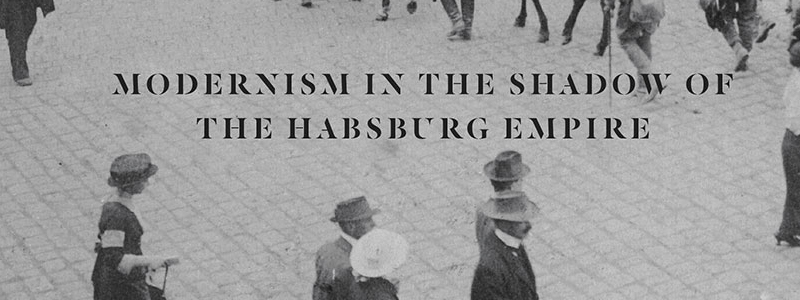
A review of Marjorie Perloff’s survey of Austrian literature, 1918-38(-1970)
Marjorie Perloff was born as Gabriele Mintz to a Jewish family in Vienna. Faced with Hitler’s Anschluss and the ensuing Nazi terror against Jews from 1938, the family left their home town for Switzerland and ultimately the US, as many thousands had to at the time. Perloff did very well in the States and, after her university years, soon became a renowned scholar of English and Comparative Literature at Stanford and USC, who did a lot to promote international poetry in particular. Her works such as The Poetics of Indeterminacy (1981), Differentials (2004), or Unoriginal Genius (2010) are well known to the discipline, as she is personally, for instance as the President of the Modern Language Association in 2006 and as the recipient of various prizes. With her recent book, The Edge of Irony, however, she goes back to her roots and tries to define what the historical and aesthetic basis of writing was in Austria during those ‘earthquake years’ (p. 153) between 1918 and 1938, and in the aftermath of the Second World War:
Austrian literature entre deux guerres was characterized by a deep irony, an irony bordering on cynicism that accompanied extreme disillusion coupled with nostalgia for a loved and lost culture [i.e., of the Habsburg Monarchy, C.R.]. In the writings of Roth and Canetti, Kraus and Musil – and of course in Kafka – there is much that is funny, hilarious, grotesque. In its extreme form, such irony culminates in the postwar fiction of Thomas Bernhard […]. (p. 143)
Perloff’s investigation is ‘aimed at a non-Germanic audience’ (p. xiii) whom she tries to introduce to this Austrian ‘literature on the edge’ (p. 18), a term she defines geographically, i.e. through the authors’ descent from the peripheries, and historically, with the end of the Habsburg Monarchy in 1918. As text corpus, Perloff presents an interesting mix of canonized texts from different genres, starting with Karl Kraus’s monster drama The Last Days of Mankind, proceeding to Joseph Roth’s novel Radetzky March, Robert Musil’s voluminous essay-novel The Man without Qualities, Elias Canetti’s autobiographical writings, Paul Celan’s love poetry, and Ludwig Wittgensetin’s “Gospel”. The Jewish focus on authors and topics does not come as a surprise, although in Perloff’s subtitle it is modernism, not Judaism that figures prominently ‘in the Shadow of the Empire’; nevertheless, between the lines, the book is very much about the relationship between the two (although the author widely ignores the existing body of German-language scholarship, and indeed not only on this subject matter).
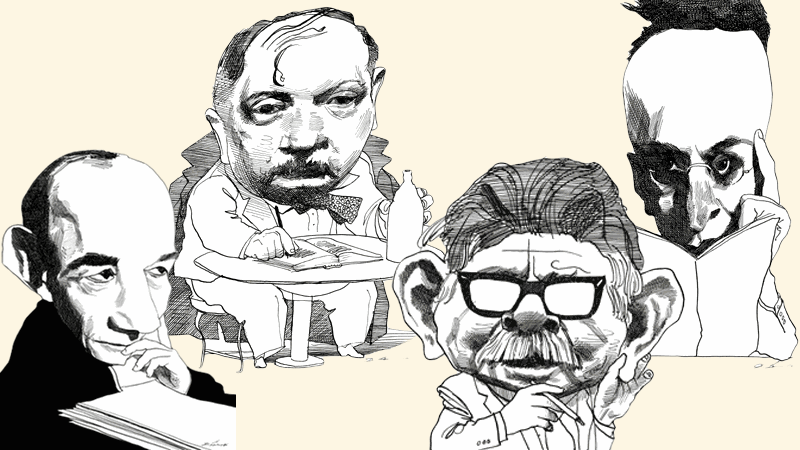
Musil, Roth, Canetti, and Kraus: illustration from NYROB’s review of Perloff’s book
Perloff is able to nominate some traits of post-imperial writing in Austria, such as Habsburg nostalgia and the shellshock that the Great War sent out to literature as well. But one could ask what makes these texts different from their counterparts in the Weimar Republic, that ‘workshop for radical ideas’ (p. 13)? The author identifies as the ‘hallmark’ of this literature ‘a profound scepticism about the power of government […] to reform human life’ and observes that irony ‘less linked to satire […] than to a sense of the absurd’ (p. 13) characterizes it. The latter hypothesis is rather questionable given the eminent satirical elements in Kraus and Roth, for example.
An ambitious but curt tour de force such as Perloff’s – barely over two hundred pages in total – must of course exclude important works and details. Still, The Edge of Irony bears interesting observations and insights, for instance, the focus on rituals (p. 58, p. 64 et passim) in Radetzky March, or when Perloff calls Kraus’s Martian-martial drama a ‘differential text – a text that is neither single nor autonomous but rather a set of variants’ (p. 26). On the other hand, Perloff provides a rather super-ficial treatment of Musil’s inexhaustibly masterful novel that many call one of the best books ever written. Also, the analysis of Celan’s opaque poetry is watered down to his love affair with another poet, Ingeborg Bachmann. And it is a particular weakness that Perloff can’t decide whether to concentrate on the First or Second Republic in Austria, but goes for a risky – and unclarified – overlap instead, which makes sense in some cases (e.g. Wittgenstein’s), in others (such as Celan’s) not.
Apart from this structural criticism, one cannot help but notice some inaccuracies or overstatements that could have easily been avoided: for example, when it is taken for granted that Musil spoke Czech through his years in Brünn/Brno (p. 11), or when Perloff mentions General Conrad von Hötzendorf’s ‘military triumph’ in the Balkan Wars (p. 22), or turns Bachmann’s father, who was a Nazi sympathizer, into an ‘SS officer from a Carinthian village’ (p. 125). There are also funny translations, when Roth’s Bezirkshauptmann (the head of a Habsburg district administration) is literally turned into a ‘district captain’ (p. 45), not a commissioner, or when a Wachtmeister in the Habsburg army becomes a ‘sentinel’ (p. 37), not a sergeant.
In conclusion, Perloff’s book might have its merits as a survey for student audiences or readers who are interested in international literature, but don’t know much about Austria. For experts, however, The Edge of Irony does not have sufficient ‘edge’; it rather comes across as a charming and sometimes inspiring causerie — with random focal points and without a convincing conclusion.
Edge of Irony: Modernism in the Shadow of the Habsburg Empire. By Marjorie Perloff. Chicago, London: University of Chicago Press. 2016. 224 pp. £22.50; $30. ISBN 978-0226054421.
(review appearing in MLR, 2018)


Leave a Reply