“Mexiko Max”
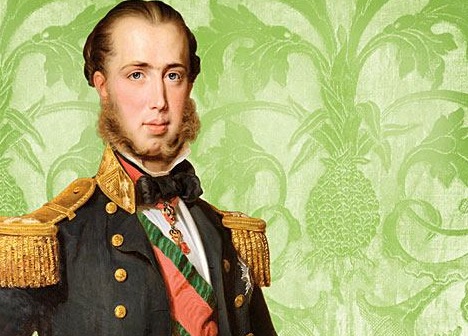
A “beautiful corpse” from the Habsburg collection is on display in Vienna.
When royal babies come into our world, we should not worry too much about their future wellbeing. Royals are an endangered species, and you don’t need to become a Shakespearian king in order to die young. Even the Habsburgs – like any other dynasty – are responsible for the death of quite a few family members. A Viennese exhibition is dedicated to one of their – other than Sisi and Rudolf – almost forgotten collateral casualties: Emperor Maximilian of Mexico, born in 1832 and dead in his thirties – a politically sensitive age, if one thinks of Jesus Christ or Che Guevara, for instance.
The current memorial site for poor Max is quite special: while we ordinary people have basements and/or attics in our nice suburbian houses where old furniture is stored and forgotten, the Habsburgs used to have the Hofmobiliendepot (Imperial Furniture Collection). This is a place on Andreasgasse in Vienna where all the furniture, which is not used in castles or administrative buildings, is stored and temporarily on display. An almost perfect venue to commemorate one of the most tragic Habsburg couples, who btw. loved to stage their lives with furniture and architecture. After all, we are dealing here not only with a famous male skeleton in the closet, but also with a prominent mad woman in the attic.
Archduke Ferdinand Maximilian, the younger brother of Emperor Franz Joseph, in one of the most absurd imperialist adventures of the 19th Century, became Emperor of Mexico with French help (Napoleon III.) in 1864. The petty Austrian power dream was to vanish soon, because already on 19 June 1867, Mexican revolutionary troops led by President Juarez placed Maximilian and two of his generals in front of a wall and shot them: the first execution of a crowned head of state since the French Revolution. Max’s wife, the Belgian Princess Charlotte, went insane even before this incident and haunted castles in her homeland as a private patient in the decades to come.
All of this provides a pretty juicy historical framework for the Viennese exhibition which starts with green wallpaper (the color of hope) before it turns into the bloody red of reality, or at least of the “oriental salons” which Max liked, like most rich people of the 19th century. Before his short-lived neo-colonial adventure, the Archduke had built himself a reputation for erecting and owning Miramar Castle in the vicinity of Trieste: building mania as an expression of unused creative energies. It was not the only architectural project of his young life, because already at the age of 17 he had commissioned the villa Maxing in Vienna (Hietzing) to be built as a kitschy alpine chalet; more mansions and palaces were in the pipeline.
The exhibition thus immerses us into a mid-19th century royal life which has bourgeois sides as well since the Habsburgs, compared to other European royal families, were rather frugal and stingy: a musically gifted boy who is interested in flora and fauna, then becoomes a naval officer, the last Viceroy of Lombardy and the manic collector of ethnological objects and historicist buildings, before he comes into a position that is too much for him and eventually kills him – to paraphrase the Peter Principle that seems to rule here.
A “beautiful corpse”, as they call it in Vienna? Not so sure about this. Some propaganda paintings, but also the existing photographs exploit the Jesus-like scene of Maximilian’s shooting in the middle of his two generals with a sombrero on his head. The Emperor had asked the Mexican soldiers not to aim at his face in order not to shock his surviving family members. It therefore took him a long time to die – because they shot him baldy – and he still returned with a pair of glass eyes to Vienna several months later, to be buried in the Imperial Crypt. You can’t blame his wife’s for her mental breakdown, if you see his punctured execution suit in the exhibition, which is shown to the public for the first time – and not locked away in the Imperial Treasury.
Details like these not only satisfy the macabre mood. All in all, the Max exhibition has become a nice little show for a rainy summer afternoon in Vienna (as a respite from shopping on the nearby Mariahilferstrasse?). Interesting and subtly Habsburg-nostalgic, as it befits a good Austrian project, but not too critical unfortunately: the exhibited fetishistic love for material culture turns the exhibits easily into devotional objects.
Exhibition open until 18 August >website
© Ruthner & LIDOVÉ NOVINY, 2013


Leave a Reply