Incisive Anniversary
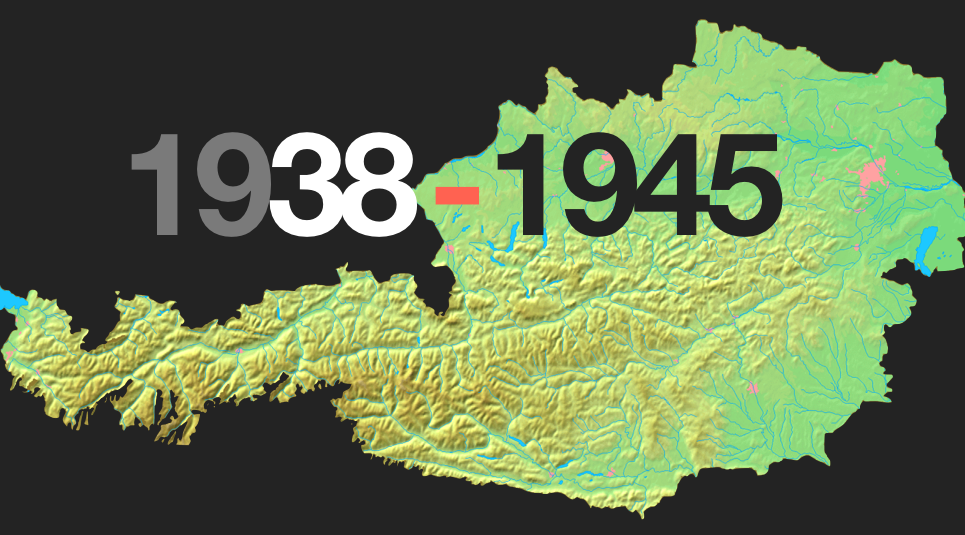
Austria commemorates again its – less forced than desired – “Anschluss” to Nazi Germany.
The current years have the annoying habit of being permeated not only by bad economic news, but also by the disaster anniversaries of our short 20th century: World War One, Two, Stalingrad, the Holocaust – you just name it. So what about the “Anschluss” in March 1938, when Hitler’s Third Reich swallowed Austria?
However, it is remarkable how in dealing with the past, a certain routine has made its way to us proverbial repressors of bad memories, to whom a quotation from the Fledermaus is commonly attributed as a motto: Glücklich ist / wer vergisst / was doch nicht zu ändern ist (“Happy is he who forgets what he can not change.”) For a good reason, this Johann Strauss operetta has been televised every year on New Year’s Eve by Austria’s Public Broadcasting Company ORF; is it time to change that?
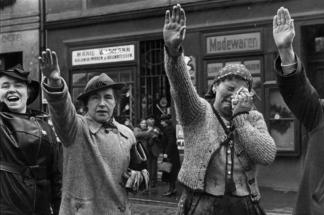 In any case, for a while now, a sentence has been gone from Austrian textbooks, which I still had to learn in high school: “In 1938, Austria became Hitler’s first victim” (meaning, Czechoslovakia comes second). If you then asked your history teacher: why so many thousand of these “victims” would cheer the advent of the German troops and Hitler on the Heldenplatz in Vienna – while in Prague, you can see mostly crying, or at least worried people on the streets – it would reap you trouble. Or self-styled eyewitnesses who would add apologetically, “we just were supposed to do this”.
After all, I had a teacher who, as a trained World War II veteran, earlier attested me “poor survival chances in the trenches” due to my body height. Around 1980, he could count on the approval of our school doctor who used to show up with a big brown Sachertorte in our school building on 20 April (Hitler’s birthday). Asked what he was going to celebrate, he would say cryptically – he was a trained hobby astrologist: “Today is a great day for Austria and Germany.”
Then, in a crispy April night, unknown perpetrators sprayed swastikas on the outside wall of our school’s gym where the doctor had his office. The Austrian Communist daily Volkstimme (People’s Voice) celebrated this as an act of unrelentingly “anti-fascist resistance” by the proletarian youth in our district (although the boys behind the operation, as I know, were rather good middle-class children – a typical Viennese constellation, I’d say.)
Today all older protagonists of these anecdotes probably rest on Vienna’s Central Cemetery: whether they do so “peacefully” is just another question. Not quite forgotten – and “worked-through”? – is the self-laceration which was caused by the Gedenkjahr in 1988: the times when the dying writer Thomas Bernhard, in his radical play Heldenplatz, called the Austrians a bunch of “six and a half million moron and maniacs”, screaming full-throatedly for a “director”, ie. another Führer. (I never figured out though what the deal was re: the other 1.5 million Austrians; I can’t believe Bernhard was ill-informed about our population number.)
Anyway, a veritable Austrian hell broke loose in 1988: Bernhard’s theatrical swan song turned the whole country into a polemical stage. The cohesion of families burst apart because Grandpa and Grandma were asked to disclose what they had done from 1938-1945; many young people thus became willy-nilly historians. At least, 25 years ago, you could talk about literature with almost every cab driver – thanks to Saint Bernhard.
All those who did not want to reveal and commemorate, however, found their advocates in our forgetful Federal President Kurt Waldheim and the sinful young right-wing politician Jörg Haider who declared the “Austrian nation” a “miscarriage”. Then, fortunately, the Wende happened in the “East”, i.e. the Iron Curtain came down and spared us Austrians another painful memory session – at least for a few years.
Nowadays, 1938 anniversaries are done with much more routine and sense of duty (a bit the the way how Waldheim saw his Wehrmacht years)? The newspapers are full with portraits of prominent Nazi victims of the first hours, such as the Viennese writer Egon Friedell, or General Wilhelm Zehner who wanted to defend Austria against the German invasion. Also the botanist Fritz Knoll who became the first Nazi provost of the University of Vienna and, after 1945, did not suffer from any significant career break, like many other scholars, judges, teachers, police officers and civil servants of his generation.
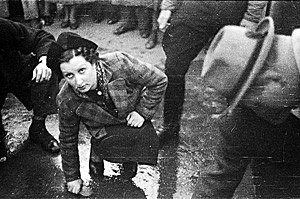 But there are still plenty of skeletons in the closet: the author Martin Pollack, for instance, presents a whole collection of photos that show Jews being forced to clean the streets of Vienna with their hats or toothbrushes. The detailed images would actually make it possible to identify not only the victims but also the perpetrators – and the grinning bystanders within the Nazi mob.
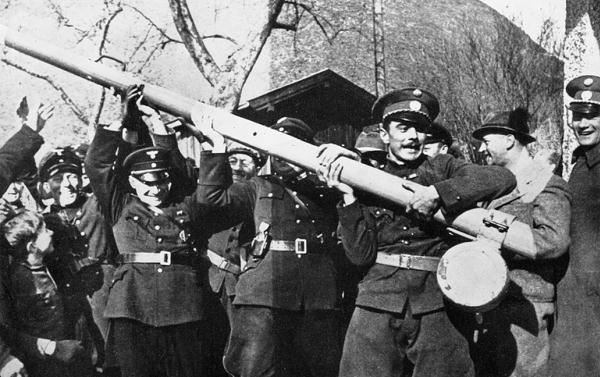 Re: the Anschluss itself, however, even the date is disputed: if you agree it’s the 12th of March 1938, you focus on the German invasion and forget that it was anteceded by a kind of coup d’état run by Austrian Nazis on 11 March. Besides, you also tend to forget that Austria had not been a functioning democracy anymore since 1933/34, but the “corporate state” (Ständestaat) of the Catholic chancellor Engelbert Dollfuss who, by inventing “Austrofascism” (light), tried to prevent the German original version on his grounds. Today, his portrait is still hanging in the parliamentary clubrooms of the conservatives: just a harmlessly nostalgic fad, like others would like to forget that Hitler was an Austrian? At such moments, I wonder which portraits we will see hung out and written in 25 years, when the last eye witnesses of the Anschluss are dead, eventually.
Text (c) Ruthner & LIDOVÉ NOVINY, 2013 >German original
 delirium clemens
2 April 2013 at 12:49
WOW just what I was looking for. Came here by searching for conference calls
14 April 2013 at 03:17
Hi there, You have done an excellent job. I’ll definitely digg it and personally recommend to my friends. I’m confident they will be benefited from this site.