Continent of Corruption
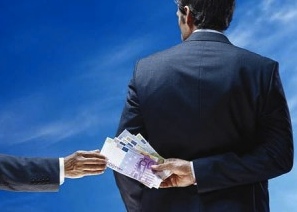
Bribes as the Lubricant of Neoliberal Central Europe
Let’s be honest: the center of Europe is not just the region of phony Habsburg nostalgia and a shared cuisine. It is also the place where experienced patients hand over a box of chocolates (with a creatively hidden banknote) to the treating doctor and/or the nurse. Where authorities are bombarded with champagne bottles before Christmas. Since, as every child knows, there are the official (and rocky) channels – and then there is the ‘easy way’ for obtaining a business licence, a building permit, whatsoever: if you give it a little ‘assistance’…
But why has the center of the continent proven to be so corrupt lately? Aside from the latency of the aforementioned phenomena in daily CEE life, there is hardly one country that has not indulged in dirty political scandals in the last few months. And there is not so much visible difference between – say – Italy, Germany, and Slovakia.
In Austria, for example, the justice system has done some soul searching for many months to see if it is courageous enough to charge a perfectly hair-styled and well-connected ex-finance minister: Karl Heinz Grasser who played a peculiar role in the privatization of state property some years ago where bribes are said to have flown like nectar. As a reaction, some Viennese comedians have put together a cabaret evening based on the released mobile phone intercepts. The title of their program: “In this respect I am supernude” – a telephone quote by Grasser’s buddy, the lobbyist Walter Meischberger. He apparently did not know as early as in 2010 what to testify at his hearing about strange “commission” payments he had received and therefore asked his friend for advice.
While Prague mayor Pavel Bém has gotten himself into trouble more recently, the “Gorillas” of Slovakia have been doing their gymnastics for quite a while. However, they all raise the same question about the relationship of privatizing politicians with investors. And in both cases, the transcripts of tapped phone calls also played a significant role, even though they weren’t used by comedians, but rather by journalists, investigators, activists and protesters.
In Croatia, meanwhile so many politicians are in custody for similar reasons as this only the case in military dictatorships otherwise. In Italy Umberto Bossi, political leader of the Lega Nord, had to resign recently; police are investigating against him and his two sons. This is quite ironic, since years ago the rightwing separatist Bossi had set out to stop the “rampant corruption of Rome”. (What a coincident that the far-right Freedom Party in Austria had formulated pretty much the same about Vienna, as they helped Grasser, Meischberger & Co. into power.)
Last but not least, former German President Christian Wulff had his petit-bourgeois dream house in Lower Saxony financed with a little private loan from friends – to put it kindly. Two other high-ranking politicians – a minister of economy and a president – had to resign in Germany and in Hungary, “only” because their PhD thesis had been plagiarized. This is, strictly speaking, rather fraud, but probably also a little bit of moral corruption, isn’t it?
It goes without saying that in all these cases, the assumption of innocence has to be made until valid court verdicts are available – if they ever are. (You surely forgive my wry smile here.) But still, what makes the region so prone to corruption: are there also cultural reasons?
What if the big corruption is just the consequence of the fact that we got used to its little siblings in everyday life? Is the whole absurd tragicomedy nothing but the dark legacy of communist or even Habsburg bureaucracy? A side effect of neo-Liberalism and its obsession with selling state property? Or is it simply a specific post-Catholic use of power in Central Europe – where usually only those make it to the top who have been around long enough in nepotistic networks and shaken paws of all kinds?
Only a few seem to see a public office connected with merits and duties. Instead they regard it as the product of Divine Grace after having been a good and humble Yes Man, leading to the big jackpot in a large self-service store. The office thus no longer holds ethical obligations (remember Havel?), but only serves its ‘owner’. This prevailing spirit is in Austria or Italy not different from the so-called “post-socialist” countries.
Perhaps transparency is also part of the problem in the information society of the 21st Century. “Supernude” are not only Meischberger & Co., but also their telecommunication intercepts on the Internet. The solution is certainly not that politicians gotta learn how to make better phone calls.
*
Text © Ruthner & Lidové noviny, 2012


Leave a Reply