‘Post/colonial’ & ‘multi-kulti’ Central Europe (necessary PS)
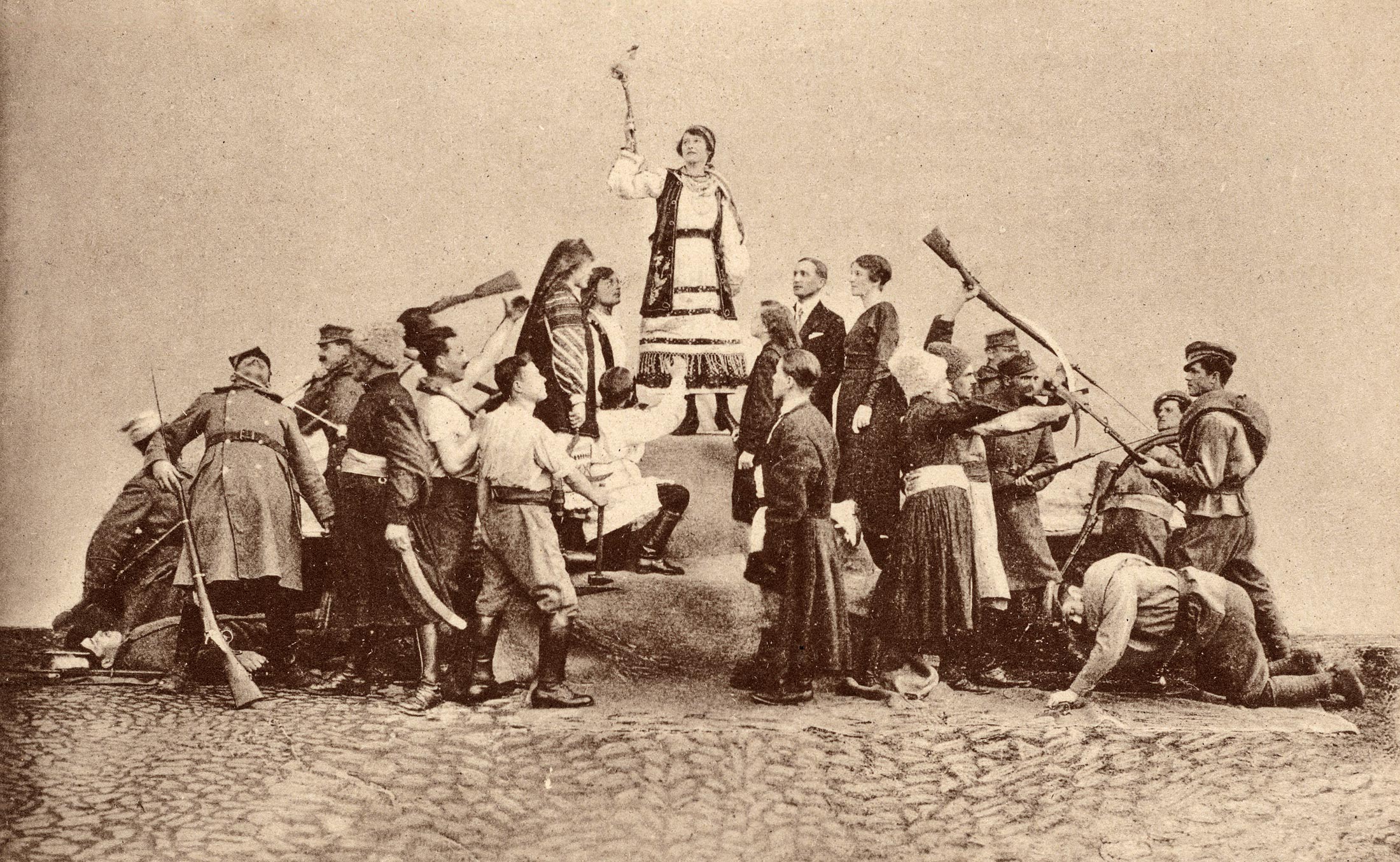
An old friend of mine has pointed out that in many countries (e.g. Canada), multiculturalism is misunderstood as multi-nationalism. According to him, each *nationality* within a multi-ethnic society constructs their little cultural backyard, an allotment garden as it were, with hedges and garden gnomes. *Multikulti* then is a mere pretext for cultural segregation and *living out* your prevailing cultural narratives (one of the most polemic examples: Islamist attempts to introduce Sharia into western judiciary) without caring too much about the others and their cultures.
I agree that this is unfortunate; but it doesn´t need to be like that. However, the situation sketched by Per has become an unpleasant reality in many places; e.g. in Edmonton, Canada, where a statue of a Nazi collaborator has been funded by the local Ukrainian community with the help of the local city council for the sake of multiculturalism.
Any segregation, and the *special rights* to do so, however, misconstrue the nature of cultures which is always hybrid, or better: a syncretistic conglomerate of inseparable parts. *Monoculture* and the aforementioned *allotment principle* mostly exists in the minds of nationalists only as a wrong hypothesis.Even they live in a hybrid context without knowing.
In this context, the problematic issue of a *Leitkultur* is often raised, too, in Germany usually under conservative governments in the eras of Kohl and Merkel. A kind of *umbrella* seems to be necessary indeed to bridge the gaps between the individual cultural monads. However, this can only be a purely formal consensus, a sort of state patriotism, which formulates the will to cohabitation in a state and its society, nothing more. Thus there is, for instance, no obligation to *become German*, but rather the commitment to living together in Germany. More would be a hegemonic imposition.
Thus real multiculturalism seems to be a crucial, albeit always precarious balancing act, with no peaceful alternative in sight. On the other hand, you never live outside of it.
Unfortunately, also postcolonial discourse is being *applied* by nationalists of the new generation currently; e.g. when Fascist nostalgias are excused with the adversities of a *Post-imperial situation* and its cultural peculiarities in – say – the Baltic states. This is a clear misuse of postcolonial theory which has criticized imperialist practices on the one hand, but on the other, warned of exclusive identity politics as a consequence. In postcolonial terms, Nationalism is revealed to be nothing but the long-durée effect of imperial power and its aftermath: following a strange master-servant dialectics where oppression provokes counter-oppression as a false solution.
In order to counter this negative power dynamics of colonialism and violent decolonization, Postcolonialism has proposed a *third way* to bypass the aporias of Imperialism and Nationalism, at least as a trajectory of thinking, if not of politics.
(c) Ruthner, 2011
Also see my post on Postcolonial Habsburg
 delirium clemens
24 May 2011 at 10:09
The big question here is where to draw the line between use and abuse of multiculturalism and postcolonialism?
Mykola Riabchuk, Volodymyr Kulyk, and others argue that there is nothing wrong with celebrating fascists, ethnic cleansers, and war criminals, as long as they only celebrate them as symbols of what we like to remember: i.e. their commitment to Ukrainian statehood and their passionate nationalism. (On the other hand they get outraged when communists in South-Eastern Ukraine applies this logic to Stalin). Thus, Holocaust ofuscationism is not only ok, it is a laudable pursuit when it benefits the imagined community. Nation building is put above universal values and basic human rights.
Is Canadian tax dollars spent on a monument to a Holocaust perpetrator an abuse of multiculturalism, or does this practice, when consistently applied, also go to groups which perceives their fascism as an authentic expression of Ukrainian culture?
I have not fully formulated my view on this, and am wrestling with this question. To me it seems like both multiculturalism and postcolonialism lends itself to these sorts of interpretations, and therefore finds natural allies among radical diasporic communities of long-distant nationalists. The multicultural logic carries the seeds of a fractured society: the support of several nationalist narratives is seen as pluralism. The individual building blocks of multiculturalism are not subjected to critical analysis, but seen as expressions of “authentic” culture. In fact, the more radical, the better. Certainly, multicultural practice has benefited the professional “ethnics” in the communities, those who present themselves as the most authentic carriers of national culture. Multiculturalism, rather than emphasizing universal values and enlightenment, seems to me like an anti-enlightenment position, a multi-nationalism of sorts that is bound to strike a chord with groups like the OUN in Canada. The very nature of multiculturalism, with its adherents claims to “tolerance,” “pluralism,” “inclusion,” not seldom in a post-colonial languge, makes it difficult to criticize. In fact, since the main beneficiaries of this policy – in Western Europe, at least – are groups with their origin outside Europe, criticism is often often dismissed as “phobia” of various kind: multicultiphobia, Ukrainophobia, islamophobia, or worse, as racism, placing also liberal critics outside the pale of what is considered legitimate discourse. Furthermore, many of the critics of multiculturalism are themselves nationalists.
Thus, what is legitimate use of postcolonialism and multiculturalism, what is legitimate use? To me, it seems like both narratives lend themselves to these forms of interpretations, and the practices we see in Canada, and many other places. My experience is that multiculturalism and primordialism go hand in hand, and has developed a comfortable symbiosis. Furthermore, its very nature has made it more difficult to criticize it. Who are its legitimate “ethnic” interlocutors? These are all important and very serious issues, and a discussion long overdue.
18 June 2011 at 17:57
Hey, youre the goto expert. Tahkns for hanging out here.
19 June 2011 at 05:22
Got it! Thakns a lot again for helping me out!
23 June 2011 at 14:36
So true. Hoensty and everything recognized.
18 June 2011 at 21:09
Thanks for sharing. Alywas good to find a real expert.
18 June 2011 at 22:30
Thats really swherd! Good to see the logic set out so well.
23 June 2011 at 15:00
Frankly I think that’s ablsuotely good stuff.
4 July 2011 at 14:30
Per Rudling makes a valid point about the unquestioning reverence to all aspects of all cultures (what we call multiculturalism or multikulti) and how postcolonialism lends itself to excusing crimes and excesses in the shadow of recent foreign occupation. The term even lends itself to elongating and maintaining that shadow. While we’re in the business of terminology, here’s a suggestion: “post-multi-colonialism” (PMC). This term stresses the historical continuity of tribes of humans trying to subjugate and enslave one another. Post-colonialism (PC) seems to focus only on the latest subjugator, whereas PMC examines the changing historical narrative as a function of both present and multiple past subjugators. After all, colonialism isn’t just a product of post-medieval Europe, it’s not just a single colonizer deal, and it isn’t dead – is it?
Is it just me, or is Ottoman-critical research in the Balkans the realm of Greeks and Serbs only? Have you read Izetbegovic’s “Islamic Declaration”, by the way? It would be interesting to read your reflections on it (I have not read it, only Misha Gleny’s brief discrediting of it).
If “post-colonialism” is the fig-leaf of fascists, racists, monarchists, fundamentalists, bigots and other would-be subjugators, then PMC could be the nagging insect that would wake these dreamers from their sleep-walk. To make PMC academically viable as a concept, it would of course be beneficial to have a written records of multiple subjugation and the natives’ reaction to each one at the time of the event, as is the case in Estonia, for example. But even in the latter example, records do not always lead to reflection. (But hey, regardless of how Estonians try to manage their collective memory, at least they make good saunas, and pretty good beer, too.)
Looking forward to your response, and to more of your writing on this blog.
11 May 2013 at 00:38
It is absolutely simpler over a lot of men and women believe.
This gadget is one of the best buys around if you
are looking for the cheapest Internet tablets. At the impressive number one spot is the Superpad 10.
17 July 2013 at 14:41
I’m truly enjoying the design and layout of your website. It’s
a very easy on the eyes which makes it much more enjoyable for me to come here
and visit more often. Did you hire out a developer to create
your theme? Great work!