Labskaus with dumplings & Dal
Do you know Labskaus? It’s the traditional sailor’s food north of Hamburg: a stodge of beef, beetroot, pickles, onions, herring, and potatoes, all cooked and then squeezed through a meat grinder. Haters of this dish – because of its gross appearance – compare it to vomit, half digested and then spat out. Those who have got used to the vague taste of it praise Labskaus to the skies as a delicacy.
A mishmash of fish and meat: that’s also how globalization is understood by its opponents. People in favor, however, love to compare it to the nifty evening buffet, where everyone takes what s/he wants (and needs?): sushi, dumplings – plus a bit of Dal, the traditional Indian lentil dish.
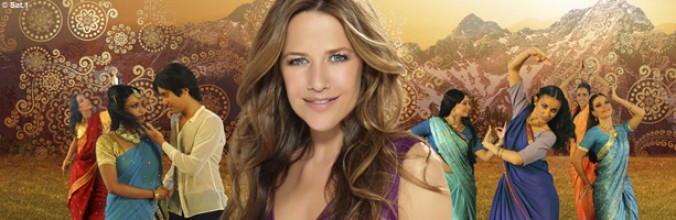
This brings us back to Central Europe, where recently an unprecedented German-Austrian film experiment was televised (with Indian spices): Bollywood lässt Alpen glühen (‘Bollywood makes the Alps glow’) is the latest stroke of genius in German commercial TV for which, as we know, hardly anything is too stupid. And since the lurid and song-loving Indian Bollywood films have been so successful in our countries in the last 10 years, they were just stirred into the German-Austrian Labskaus by SAT1.
The plot is simple: the sweet Viennese producer Franzie (played by German Fräuleinwunder Alexandra Neldel) must find a few exotic locations in the Alps for an Indian movie production. This seems to be quite normal in this business, and so Franzie does not bat her false eyelashes too long. She recalls Sankt Maria, that pretty God-forsaken little mountain village with the very inventive name (it´s sooo Catholic). She was raised here and later left for the high life in the city, where she cleaned the cow shit off her designer boots. Of course, her village has always resented her desertion of the native dung. However, the kindness and, above all, the financial potential of the Indian film crew changes this for the better; after some initial misunderstandings – over girls, of course – soon Lederhosen and Saris are dancing on the set in perfect harmony. (It’s sooo sophisticated: the film within the film.)
Anyway, the Indians bring money and emotion to the mountains, and even Franzie´s single father, deeply afflicted by a sad life, experiences love again – with a crusty Indian widow who runs the film crew’s catering service. But the successful and stressed-out neo-urbanite Franzie also does well in her native village St. Maria with her ex. Over this increasingly idyllic scenery floats the eternal Asian wisdom of the Indian Bollywood star Amit (played by the Arabic-German actor Omar El-Saeidi); for instance when he says to Franzie: ‘Home is not always beautiful, but you carry it in your heart.’
St. Maria itself is not only a potential global village, but is also otherwise easy to connect with for the Austrian and German audience. Here live true Austrian country boys (archetypically played by the two ‘guy guys’ Wolfram Berger and Andreas Kiendl). But since the TV film envisages the whole German-speaking world, there are also some Prussian-sounding actors and – as one of the few reality signals – an East German cook (who other than Uwe Steimle?): not too far fetched, since a couple of years ago a few – of course unchauvinistic – Tyrolean hoteliers and restaurant owners found out that Ossis from the ex-GDR were not more expensive to have in the kitchen than Turks – and they speak German a bit better.
Even the German TV critic Rainer Tittelbach, hard-boiled after 25 years of service to the public, grows enthusiastic here and writes: ‘Bollywood lässt Alpen glühen is great fun. But you have to bring along a few prerequisites as a spectator: the penchant for kitsch and slapstick, for pop culture and party, for folk costumes and trash, for line dancing and Schwarzenegger’s native country. This SAT1-comedy is a film in which one can safely forget about thinking too much.’
Cheesus: that´s all you can say in reaction as a born & bred Central European. But is there more to get from this comedy of international understanding and intercultural learning in the mountains? Is the whole thing just wishful thinking from the great philosophical School of SAT1-Humanism – a multikulti fairy tale to appease our bad conscience?
Actually, the film could make us even more aware of the prevailing xenophobia in our picturesque small Central European villages: ‘Home is not always beautiful, but you carry it in your heart’: a dangerous threat? Is the film´s hidden cynical message here that money can indeed buy you love, whatever your skin color is? ‘Good’ business trips and tourism are presented as an answer to ‘wrong’ immigration (staged with the help of some immigrants btw.). It speaks for itself that – except for Franzie’s dad – no mixed couples are formed. So, in a way, everything stays the same in Sankt Maria; the Austrian way of life, televised in Germany?
A little reality check: I think of all the poor African asylum seekers who are driven in minivans through the Lower Austrian province as cheap labor for commercial flyer distribution; all they get apart from little money is very often the N-word. Or, Kinder statt Inder (‘Kids instead of Indians’), that hyper-intelligent German election campaign slogan. It was coined in 2000 by the conservative politician Jürgen Rüttgers (who served until 2010 as Premier of the federal state North Rhine-Westphalia), after it had been leaked that Germany was planning to attract professionals from India for its IT industries. Rüttgers definitely did not participate in the script-writing of Bollywood lässt Alpen glühen. However, the message there seems to be: Well, as long as the Indians fulfill the Orientalist stereotype, i.e if they are colorful but well-off, shoot a film, sing occasionally, leave some money in our village and know when it’s time to go home, everything is fine and the status quo maintained. And otherwise?
Speaking of the devil: On 30 April 2011 the last EU-access restrictions for Czechs, Slovaks, Hungarians, Slovenes, Poles, Romanians, Bulgarians and nationals of the Baltic states on the Austrian and German labor market will be lifted – finally. Will SAT 1 forge a colorful soap opera out of this? C’mon, it’s just TV.
(c) Clemens Ruthner & LIDOVÉ NOVINY, 2010
Other languages> German original + Czech translation (by Lucie Zidkova)
 delirium clemens
23 April 2011 at 00:39
would love to perpetually get updated great site ! .