“Old Auster & Hungrig” on vacation
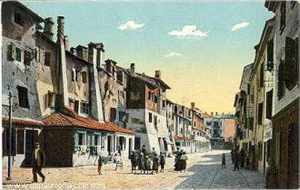
On summer days like this, I sometimes return to Grado, the old Adriatic resort of my childhood. It is still populated by Italian, Austrian and German tourists, and increasingly Hungarians and Czechs, and it smells nicely of pine, sea, foreign cleaning products and Aperol-Spritz. Then I sometimes think of Kakanien, whose ghost is somehow even more tangible here than in Vienna or Prague. At least during the summer.
‘Kakanien’: this is Robert Musil’s word for the ‘k. & k.’ Habsburg monarchy. It sounds a bit anal for Slavic ears, but maybe this was intended, as Joseph Roth claims. Anyway, it is this term by which the author of The Man without Qualities, probably the best novel on this planet, referred in an affectionately ironic way to Austria-Hungary-Bohemia-Moravia-Silesia, including Slovakia, Slavonia, Slovenia, Transylvania, etc. etc.: in a word, the huge land of unlimited impossibilities that perished in 1918.
A semi-colonial state in which a dozen ethnic groups lived side by side and made each other’s lives difficult. Socially and politically disastrous, but culturally fruitful: a twelve-tone waltz under the volcano called World War I, orchestrated by Freud & Co. A ‘prison of peoples’ in the eyes of the ardent nationalists of the time, a ‘powder keg’ for historians, and a multicultural paradise for naïf Habsburg nostalgics later in the short 20th century which was to face the catastrophes of two world wars, several genocides, Hitler, Stalin, Mussolini, Horthy, Tiso, Pavelić, and all the other devils of the hell called Central Europe then.
‘Kakanien’ was not only the happy yesterday, but also the prehistory of nationalist hatred and the holocaust in the region. And it is quite ironic that Musil wrote down his essayist maze of thoughts on the late Habsburg Monarchy when in front of his Kurfürstendamm apartment in Berlin the Nazis were already marching by.
However, ‘Kakanien’ was also the forerunner model of the Mitteleuropa hype of Milan Kundera, György Konrád, Danilo Kiš & Co. between the 1970s and 1990s: a political stillbirth which never got out of intellectual intensive care, before it was buried by the EU for good with the accession of most Central European countries in 1995 and 2004. Nevertheless, Mitteleuropa served as a sort of balm for many tormented souls enslaved by the various totalitarianisms in the region post-1918; they probably forgot that the term had been coined by Friedrich Naumann in 1915 as a tool of aggressive geopolitics in the German ‘backyard’.
Is Mitteleuropa just Postimperial melancholy? a sort of Trauerarbeit, or the clandestine comfort for Central Europeans that, in a certain period of time, they were among the imperial bosses themselves, ‘k.&k.’, with one of the Great continental Powers, or at least not oppressed too hard? The two mass murderers of late Kakanien, Emperor Franz Josef (on European tour in 1848/49, 1865/66, 1878, and 1914-18) and his beatified successor Karl I, whom students at the Vienna University love to call Giftgas-Charlie because he ordered poison gas to be used at the Italian front in WW1: both were nice uncles, indeed, compared to Hitler and Stalin.
So is brooding over Kakanien a less complicated and delicate affair than, say, ‘thinking of Germany at night’, which sleepless Heinrich Heine, the sarcastic Jewish-German-French author, already did in 1844 (in Germany: A Winter´s Tale)? The Irishman James Joyce, who in the early 1900s lived nearby Grado in the seaport of Trieste / Trst / Trieste, that fascinating Italian-Slovenian-German amalgam at the Adriatic coast, is an unsuspicious witness in comparison to the hidden agendas of many others. In Finnegan’s Wake, his brilliantly unreadable literary creation, Joyce finds a fitting term for the Habsburg monarchy: Old Auster & Hungrig. Austria-Hungary sounds a bit like ‘hungry oyster’ here – an overdesigned fish restaurant whose volitional coolness has become unintentionally comical?
On the other hand: what has really changed in places like Grado, except for the ubiquitous plastic rattan furniture? Otherwise, it has pretty much been spared globalization and ugly high-rise buildings. The local, family-run hotels receive their holiday guests in the same friendly and old-fashioned way as probably a hundred years ago. Most of the tourists are still coming from the area between Berlin, Prague, Vienna and Budapest, and sometimes in the third generation already; only the names of their countries have changed slightly. As hotel owners like to claim, Austrians and Czechs are supposed to be even better clients than, say, the Germans, since they are ‘close relatives’: is this the Habsburg myth, or just the professional opportunism of the tourism sector?
So again, what has changed? The languages of traffic in Grado have remained Italian and German; a bit of English is excusable. Most of the guests still have the same currency in their pockets (Crowns long ago, now Euros), and most families relaxing here, as well as many locals, have dead ancestors out there on one of the war cemeteries in the badlands of il Carso: where our great-grandfathers fought 1915-18 to prevent an Italian area, the hinterland of Trieste, from becoming Italian. Absurd, isn´t it? The memorials of World War II are kept much more low-key here, since they could work to polarize Italians and their holiday guests.
Today, there are parliaments in all our capital cities and almost no borders left in ‘Schengenland’, but the real government is still – or again – ‘elsewhere’, as Alfred Kubin put it in 1908. So what’s the difference? Is the EU the new Kakanien, has it, to quote Kafka, woken up from a ‘night of restless (‘k.&k.’) dreams’ and turned into a beetle, or driven out the ghost?
The question is clearly what holds us together as a ‘region’, and what separates us. Is it the fact that old railway stations between Vorarlberg, Austria, and the western Ukraine look alike? Or that we deceive ourselves about sharing a common experience, just because our grandparents kept similar junk in their cupboards? On the other hand, the huge bills of history seem to be mostly settled in Central Europe – or sold off like the ubiquitous Habsburg kitsch. Which new troubles the present economic crisis will hold in store for us and unevenly distribute, we don’t know yet.
So what is Central Europe, roughly summarizing Dragan Velikić´s thoughts, other than a shared cemetery, a theme park, a flea market, a phone book with unspeakable names and a tourist menu: a nostalgically trimmed holiday resort like Grado? Maybe I should go to Turkey next year to shake off the burden of ‘our’ history. Madeira is no good: Giftgas-Charlie is buried there.
.
© CLEMENS RUTHNER & LIDOVÉ NOVINY, 2010-11.
LINKS: German original text + Czech version (transl. Lucie Zídková)


Leave a Reply