THE WORLD WITHOUT THE SHOTS OF SARAJEVO
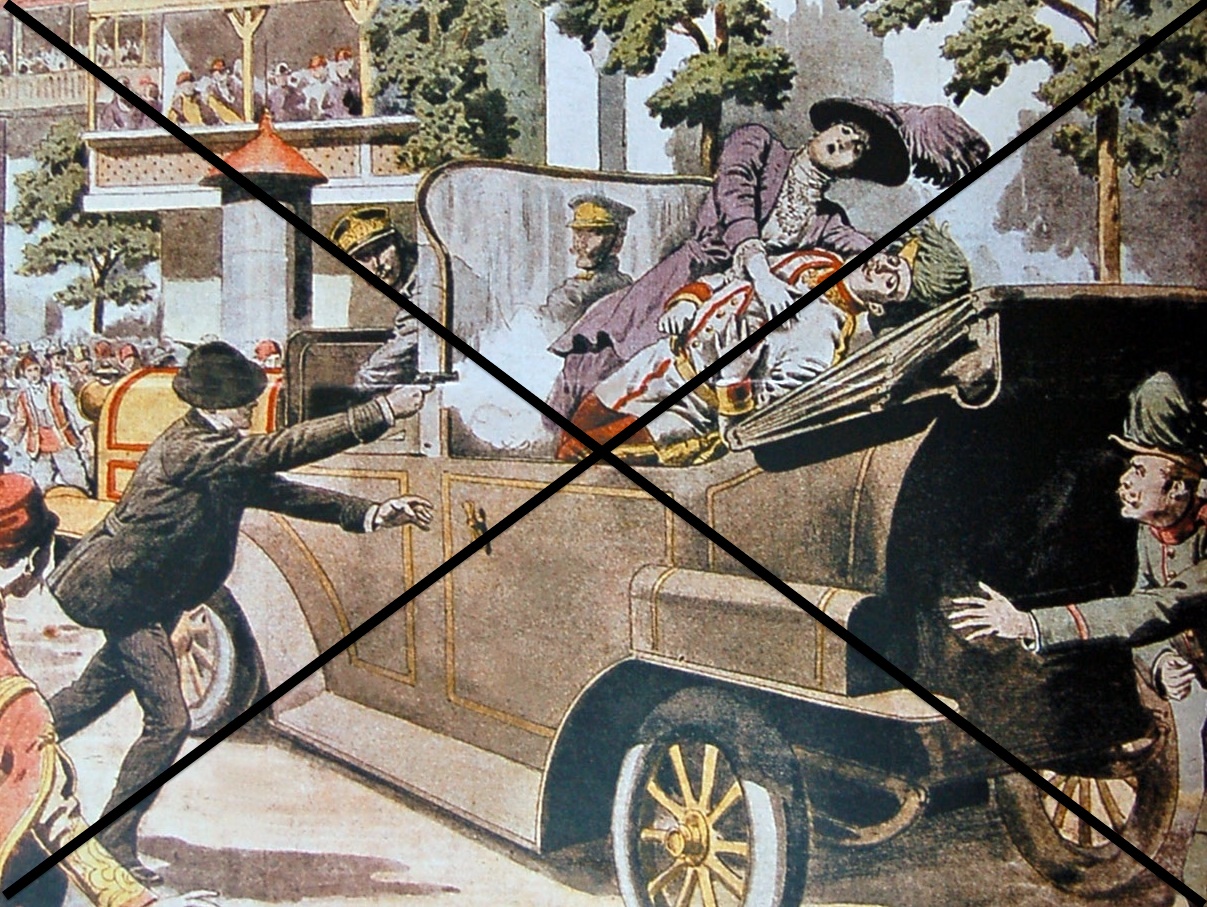
A German novel imagines: what if ?
Hannes Stein, a German author who grew up in Salzburg and lives as a foreign correspondent in New York, has published a novel in the alternate history genre: The Comet.* The basic scenario of this successful book is quite simple: after the first unsuccessful bomb attack on his car, Archduke Franz Ferdinand tells his Czech driver to make a U-turn on that 28 June 1914: “I’m not dopey, let’s go home.”
Thus, the Habsburg Crown Prince, his wife and his Serb would-be assissin, Gavrilo Princip, stay alive, the First and Second World Wars never take place, neither the Yugoslav conflict nor the Holocaust. As a result, the Austro-Hungarian Monarchy has existed until our day, the German Empire has colonized the moon, and women eventually received suffrage after the student revolts of 1968. America remains “a sort of Switzerland of the size of a continent” and Auschwitz “a podunk town down there near Krakow”.
What we call the banal brutality of ‘real’ history never happens in this novel. It only haunts a minor character of this novel, the engineer Biehlolawek, in his nightmares. All the madness of the “short twentieth Century” of 1914-1989 (Eric Hobsbawm), its high amount of political violence exist in his head only and keep only his psychotherapist busy (who is Freudian, of course). According to a truism, paranoia is just an accurate sense of reality, indeed – but here, simply nobody believes this patient. Happy is he who can forget what has never happened.
All of this goes well so far, until a comet from outer space threatens this best of all Habsburg worlds with extinction… This prae-apocalyptic situation creates the need for a narrative that wants to preserve what is is going to be lost: a looming, but still funny doomsday with the reader as a spectator.
The author has researched his topic very well and has stewed a quite wholesome and enjoyable novel out of it, with handpicked ingredients from literature and cultural history: a postmodern potpourri in which you will always find recognizable bits if you try. There are not only borrowings from Johann Nestroy and The Simpsons (which, as is well-known, are also hit by a comet once), but also from the good old Joe Roth (Radetzky March), from Fritz von Herzmanovsky-Orlando and of course from then novel’s closet patron saint, “Bob” Musil.
Yet Stein’s attempt to create a broad fresco of an alternative world makes the actual plot fade. There is not much more than a bit on the side for his peripheral protagonist Alexei Repin, an affair with with Barbara Gottlieb that starts in her swank salon, while her husband, the Jewish court astronomer David Gottlieb (aka “Dudu”) makes his way to the moon to avert the disaster. There, Dudu does find a bit of erotic relaxation, too, but no a(u)stronauts of the caliber of Bruce Willis rush to his help to dispose of that comet. The ranting philosopher André Malek, however – who repeatedly proves to be a party crasher in the celebration of harmony of this sci-fi Habsburg Empire – gets disposed of by a flowerpot on a stormy day, which drives him into the Orcus of the narrative. But will the Best of All (“k.u.k.”) Worlds survive?
Alternate history is used here as an ironic medium of reflection (and refraction) of the “Habsburg myth” which the Triestine Professor Claudio Magris found in Austrian literature. Why the novel particularly end with a group of Islamic clerics from Sarajevo at the Vienna Cobenzl needs to be explained though. Maybe it’s the bygone undamaged multiculturalism of the Empire, which is mourned here by Stein – even if it’s only a political fiction itself, as we know.
*) Hannes Stein: Der Komet. Roman. Berlin: Galiani, 2013. 271 S. € 19,60
Review © Ruthner & LIDOVÉ NOVINY, 2013
 delirium clemens
24 November 2013 at 15:10
Great info here thanks for posting