Militant mountain people?
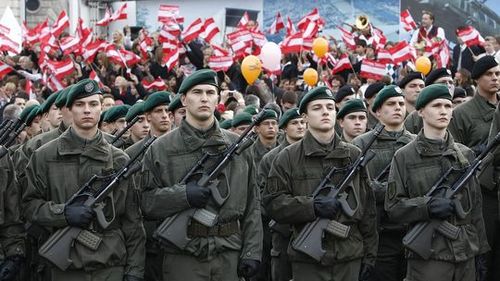
Austria is probably the only modern state in EUrope whose voters have not abolished the draft in a plebiscite.
When Austria, after some political tug-of-war, on 20 January finally carried out a referendum about the end of general conscription (and the introduction of a professional volunteers’ army), almost 60% of the participants voted against. Instead of stepping back, Norbert Darabos, the Socialist Minister of Defense and key promoter of the abolishment, stepped forward and asked for a few millions to spend on new arms and equipment: once again he had proven to be a good party soldier and a quick-change artist.
Those opposing conscription gained a majority in Vienna and among young voters only – and were defeated by their parents, grand parents and the rural population in general. Apart from this being another sign of Austria’s proverbial „authoritarian character,“ analysts assume deeper motives such as sneers and Schadenfreude behind this collective decision making, obviously following the rational: „since I have wasted 6 to 8 months of my life, my son should go through the same hardship.” That’s how trans-generational solidarity works in Austria.
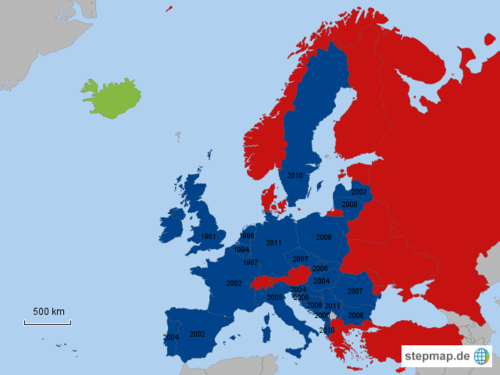
Thus the country belongs to the handpicked club of states in Europe that still think they should afford general conscription. As much this might be at least psychologically understandable when it comes to Greece, Finland and Estonia (because of their big bad neighbors): it isn’t in the cases of Switzerland and Austria.
In both countries, conscription is not only the brain child of the Cold War, but also of a specific policy of “neutrality” which goes back until 1815 in Switzerland (and even longer), but only until 1955 in Austria. In that year, the four great victors of World War Two ended their occupation of the country, differently from the situation in Germany. Austria, in return, committed itself to “armed” non-alignedness to either of the great power blocks, neither NATO nor the Warsaw Pact.
Actually, the secret deal Austria cut with the NATO was: in case of a Soviet-led invasion of the country (anything else was never a serious assumption in any of its army manoeuvres), Austria was supposed to defend itself for three days before the Western alliance would come to its aid. However, nobody looking at Austria’s “chunk yard army” (as journalists called it in the 1980s) would seriously believe in its military potential. Not even precarious (P.R.?) missions to protect the state frontiers in 1956, 1968 and 1991, or spectacular (and scandalous) purchases of fighter jets could change this perception. The criticism rather increased, after the Bundesheer was employed in the 1990s to hunt down illegal immigrants at the Hungarian border.
Nevertheless, the compulsory military service of all male citizens has always been part of the state ideology of the Second Republic of Austria from 1955. After a professional army had helped to suppress an anti-Fascist workers’ rebellion in 1934 and to establish a conservative Catholic dictatorship under Engelbert Dollfuß, the successor state of that unfortunate First Republic loved to repeat the mantra of universal conscription as “the School of Democracy”. The coup d’etat in Portugal (1974) and the Romanian “Revolution” of 1989 (which turned out to be a staged blood operetta) served as shining examples of how a people’s army in the long run would render any dictatorship impossible. The Yugoslav Succession Wars (1991-1999) – as gory epitome of what happens when every male adult is able to handle a gun – were rather ignored in this respect.
Unfortunately, the martial little hedgehogs in the Alps have lost their global threat scenario with the end of Cold War already. It is not very likely that Slovenia would offer military help to its subjugated folks in Carinthia; neither that Hungary seeks to re-conquer the Burgenland (after it became Austrian in 1921) or that the Czech Republic invades the partitioned border town of Gmünd / České Velenice to reunite it again.
But still, Mr and Ms Austrian stick to general conscription, even if die-hard militarists and the Green Party can agree that a professional army would be the clearly more efficient solution. According to an estimate by the Ministry of Defence, only 10-20% of the annual conscripts learn the classical soldier’s craft of war. The remaining recruits bore themselves to death in stupid wastages of energy as Systemerhalter: to keep an oversized military “system” alive which has been dead for a while.
The only good news re: the outcome of the referendum is: with the continuation of the draft, Zivildienst (civilian service) stays in place as well, without which hospitals, ambulance services, retirement homes and other parts of the health system would probably collapse. A compulsory, gender-neutral “Citizen (half)Year” for all 18 years olds, however, probably seemed a too Communist thing to do to politicians and voters. We’d rather remain a militant mountain people; that’s what we are.
Text (c) Ruthner & LIDOVÉ NOVINY, 2013 >German version
Illustrations (c) DIE ZEIT, 2013; stepmap.de


13 March 2013 at 03:38
I do believe all the concepts you have presented to your post.
They’re really convincing and will definitely work. Still, the posts are too quick for beginners. Could you please extend them a bit from subsequent time? Thank you for the post.
17 March 2013 at 00:53
Awesome post.
25 March 2013 at 00:43
Pretty! This has been an extremely wonderful post.
Thank you for providing this information.
14 April 2013 at 09:55
I like this post, enjoyed this one thanks for putting up.
27 November 2013 at 20:49
My partner and I absolutely love your blog and find the majority
of your post’s to be exactly what I’m looking for. Does one offer guest writers to write content for you?
I wouldn’t mind composing a post or elaborating on most of the subjects you write regarding here.
Again, awesome site!