A Venial Sin of History
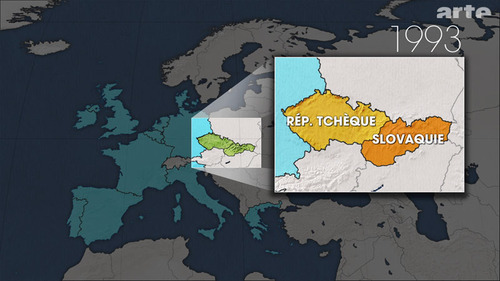
Reminiscences of the Czech-Slovak divorce twenty years ago
My first reaction to the independence ambitions of Slovakia between 1989 and 1992 was anger. In my eyes, the Slovak leader, Vladimír Mečiar, was not a flawless democrat (because he did not want a referendum) and the Czech president Vaclav Klaus a man with questionable motivations (because he did not show his fist to the troublemakers really). Within the circles of my Viennese friends, it was heavily discussed which (democratic?) means could be used in Prague to force the country into a general referendum, the probable outcome of which would have been not in favor of independence.
I also recall having accused Klaus of being a bad president who was incapable and/or unwilling to look after his folks. Who threw his Slovak fellow citizens out instead of protecting them from right-wing nationalists. I also resented ‘the other Vaclav’ for having resigned in the summer of 1992 in a manner of political sulking. (To my dismay I must say that in my memory, I have often mixed up Václav Havel with Václav Klaus when it came to those days.)
But out there Havel was not a falcon, but a dove dwelling the castle towers of Prague, and Klaus a pragmatic accountant, simply closing the books. And in fact the “dismembration” – that’s how the political scientists call it – went well and smoothly, especially when you consider what male policies of toughness could lead to in those years: how, for example, the big reformer Mikhail Gorbachev wrecked his reputation by sending tanks to the Baltic states; let alone Yugoslavia…
Anyway, in 1992-93, I was pretty close to historic action, being an Austrian lecturer in German language and literature at the University of Budapest (ELTE). My girlfriend did the same at the Comenius University in Bratislava. The weekends we spent in Vienna: a commuting lifestyle with a little Habsburg touch by a young couple that was just happy about their first real job after graduation.
Then, unimpressed by our discussions, Slovak independence came about in real time on 1 January 1993, and with surprise my partner suddenly found herself in a new capital which had been a provincial metropole before, right after the Christmas break which had been the time for the national break-up as well. The Slovaks celebrated and then quickly switched to a new mode of normalcy so that their new state would soon go-without-saying. The older Czechs whom I knew were shocked; most of the younger ones whom I would get to know later increasingly responded with a shrug.
It even took some time to get used to the new name of the state, as Tschechei was not politically correct any more in German after the events of 1938, and Tschechien (Czechia) sounded unnatural. The Slovaks had it easier (although they are still mixed up with the Slovenes, particularly by English speakers.)
All these things have repeated themselves several times in my life, in variants. I have witnessed the collapse of Yugoslavia, partly as a bystander (not from far away, but still from a distance); Vilnius, Riga and Tallinn, on the other hand, were still behind the horizon for me when their inhabitants fought it out with the Red Army in the winter snow.
Then I lived in Antwerp for ten years. Nevertheless, my prediction that this Nordic beauty would become the capital of a Flemish Republic one day has not come true so far – but twice almost: The state of Belgium is like the proverbial old aunt in a nursing home, who is terminally ill, but still survives her would-be heirs tenaciously. A dismembration is likely, but not available yet.
After an interlude in Canada (where I was introduced to the Western-style “Let ’em go” reaction of many Anglophone citizens to Quebec aspirations of independence), I have been living on a green island since 2008: the only country in Europe which split off from an empire through revolutionary violence and still is a success story – Ireland (although the “Celtic Tiger” has rather looked like a drowned kitten after the economic crisis of 2008). I recently bet 100 euros that I will be able to witness the ruin of the rest of the United Kingdom in my lifetime. As a trained Austrian, however, it’s hard for me to say if I am going to be happy about it or sad.
Just post-imperial Schadenfreude? Actually, throughout my life I have always had mixed feelings about which type of collective setup is better. Multi-ethnic states have to make excessive political and economic efforts in order to survive; on the other hand, they exude a strange charm and their culture is certainly richer. Nation-states, on the other hand, seem to be the evident format, slimmer, cheaper, more modern, but also more petty-bourgeois and provincial in their cultural life, and with a peculiar aggressiveness which is not always passive.
However, it has been one of the biggest mistakes of the 20th century to believe that the (often violent) break-up of large multi-ethnic countries automatically would lead to nation-states. What rather came out in the process were smaller multi-ethnic entities in which only forced assimilation, expulsion or even genocide would bring about monoculture – which in the maelstrom of globalization would dissolve slowly into multicultural agglomerates again: a paradoxical, but still gory movement which has cost the lives of many millions.
Czechoslovakia, however, split up into two independent states peacefully. And nowadays, while driving by the decaying then-new border stations from the 1990s, it makes me smile how soon after the two countries were to become part of Schengenland. With Václav Klaus, I’ve made my peace, because in a sort of violent Parallelaktion to his compliance, the Serbian president Slobodan Milošević pushed through his agenda and with it the true tragedies of the 1990s: the atrocious wars in Croatia, Bosnia-Hercegovina and Kosovo (which probably opened the eyes of many light-hearted nationalists all over the continent). In comparison, the Slovak secession was only a venial sin of history.
Somehow, I even started liking the new neighbor Slovakia like bad habit – especially since the unspeakable Ryanair flies me directly to Bratislava, in the vicinity of Vienna. Eventually, these two cities will grow together into one – and they share quite a lot indeed, except the language. Now already, in a strange way, the EU has brought together again silently what nationalists separated in the last centuries with a lot of efforts. This, however, doesn’t make me believe that Brussels is the New Moscow, as Václav Klaus said preposterously a few years ago.
(c) Ruthner & LIDOVÉ NOVINY, 2012 >this text in German
>alternative text in English(c) wieninternational.at 2013
 delirium clemens
5 January 2013 at 21:11
Blog…
I’ll immediately grab your rss feed as I can’t in finding your email subscription hyperlink or newsletter service. Do you have any? Kindly allow me recognise so that I may subscribe. Thanks….