Playful Economy
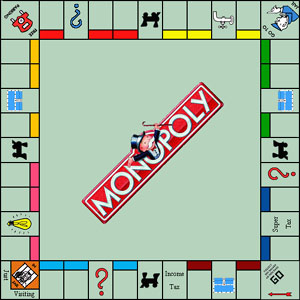
The history of the board game Monopoly
During our childhood in the last century, rainy afternoons were the setting of a sadomasochistic little pleasure. We opened a box and spread out a board, got dices, toy money and houses. Then, at some point, the boy next door had to pay thousands for the rent on “Schlossallee” and, shortly afterwards, he would land in “jail” (big grin on the faces of the other players). A place which would take Karlheinz Grasser and his buddies years to go to: here it was always just a roll of the dice away.
The famous board game Monopoly is cultural history in miniature, as the German art historian Andreas Tönnesmann has written in a readable book on the subject. In his eyes, Monopoly would be a perfect symbol of our culture: if alien archaeologists would find it one day in thousand years from now, they would perfectly be able to understand what made us tick.
Not only Agatha Christie’s detective Poirot or Monty Burns from The Simpsons play the game: Monopoly has sold more than 275 million copies in the 77 years of its existence, making it the most successful commercial board game of all times. In comparison, Ludo (Mensch ärgere dich nicht) which owed its success to World War One, when German soldiers needed to kill some time, only sold meager 75 million.
The invention of Monopoly, however, is a lesson in U.S. economic history. Charles B. Darrow, the (foster?) father of the game, was born in the same year as Wittgenstein or Adolf Hitler, both of whom he would survive pretty successfully: he has served for thousands of wannabe inventors as a role model, including the legendary Alex Randolph (1922-2004) and a number of academics.
Originally from a suburb of Philadelphia, Darrow registered Monopoly for patent on New Year’s Eve 1935, in the days of the Great Depression which the new President Roosevelt sought to overcome with his New Deal policies. Some million idle dreamers, frustrated by the American Dream, were virtually available for a little escapist fantasy of a new, economically successful life which is ultimately decided by a dice; just as easy as that.
Monopoly also provides basic training in a capitalist behavioral pattern which psychologist Rolf Haubl calls “damagingly hostile rivalry.” Indeed, playing the game not only requires fatalism, but also recklessness plus antisocial and malicious attitudes.
Thematically, Monopoly revolves around real estate bubbles: The winner is the one who most consequently invests money into lots and buildings – and then generates more money from random ‘tenants’ by squeezing ‘rent’ out them. The other players are left in debt when at some point the rent is more than the original purchase price. There is no real industry available on the Monopoly board, only urban infrastructure (which you can buy in the bad American way) and revenue services. Unshaken by all of this, the only bank there (which belongs to no one!) survives: sounds familiar?
After Parker Brothers Co. had rejected Monopoly as faulty in 1934, Darrow finally signed a license agreement with the renowned game company on 19 March 1935. This would enable him soon to live on the royalties only at his farm. In the fall before, he had sold a few hundred handmade copies of Monopoly at Wanamaker department store in Philadelphia; in the spring of 1936, Parker Bros. already sold 20,000 units – and a British version of the game.
There is reason to believe that the “infamy” that is needed to successfully play Monopoly according to Tönnesmann also inspired Darrow himself. Already in 1904, there was at least one precursor: The Landlord’s Game, invented by the stenographer Elizabeth Magie, which never reached a great success. In 1909, Parker Bros. had rejected this board game as “too complex and political.” In November 1935, however, Darrow’s chief George Parker in person coyly bought the patent from the inventor for $500. The path from plagiarism to monopoly was free.
As a good cultural analyst, Tönnesmann has explained not only the success but also the deep structures of the board gamein his book. He is able to show how, expanding on The Landlord’s Game, Atlantic City served as template for the mundane English street names of the anonymous city in Monopoly, too. The associations with the popular sea resort – along with the dream of owning property and assets – certainly have contributed to the success on the North American continent.
Meanwhile Monopoly comes in 43 country-specific spin-off versions, which is supposed to trigger a special “sense of home” in their buyers, but it also tells a lot about the historical circumstances of production. Emilio Cerretti, the godfather of the Italian Monópoli, for instance, in the late 1930s chose Milan, not Rome, as model for his game board. The Swiss variant tried in a politically correct way to image the multilingual composition of the state in cantons, as does the multilingual Belgian version of 1938, which should disappear later.
Bizarre indeed is the German and Austrian history of the game when the totalitarian fight for political monopoly just raged outside the door. In 1935, while Charles Darrow rigged his imaginary buildings, the New Reich Chancellery in Berlin was built for Hitler.
A persistent rumor holds it that propaganda minister Joseph Goebbels himself polemicized against the “Jewish nature” of Monopoly and that the Hitler Youth put pressure on toy stores to take the board game out of their shop windows. Tönnesmann, however, thinks he knows the real reason: the residential Schwanenwerder island where Goebbels and several Nazi bosses lived “was emblazoned on the board as a forerunner of today’s ‘Schlossallee'” with 8000 Reichsmark rent – and thus conveyed the critical image of exaggerated Nazi pomp to the people of Berlin.
In response to Nazi pressure, too, the existing local versions of the game were forced to morph into the still existing clone DKT (“The Commercial Talent”) after the Nazi annexation of Austria in 1938: “Idyllic vistas of Austrian cities adorned the board and this differed significantly from Darrow’s sober original design”(Tönnesmann). Thus we can still find the small town Amstetten as the place of imaginary property purchase: whether that dream of owning a home there has probably changed since the basement incest case of Ingenieur Fritzl, is unknown.
In any case you can also read the disastrous history of the 20th century from the Monopoly board. In 1942 the artist Oswald Poeck, detained in the concentration camp of Theresienstadt, produced a local version of the game called Ghetto, which many inmates used to kill the time before before their imminent deportation to Auschwitz. And when in Moscow the U.S. Exhibition was held in 1959 where the ill-tempered Khrushchev had to drink Coca Cola in public with Richard Nixon, there was a copy of the board game within reach to rub it in the Soviets’ faces (it was soon reported stolen). In East Germany, however, the import of the “arch-capitalist” game was strictly forbidden.
Multiple radical currents attempted to hijack the game, especially as the plagiarist character of Monopoly was revealed in the 1960s. Thus, neither the 1968 student and hippie revolutions nor the subsequent green grassroots movements left Darrow’s capitalist model city unscathed.
At San Francisco State University, the Jewish German professor of economics Ralph Anspach who had fled from the Nazis developed a counter-version of the game, whose aim is to destroy monopolies. In 1978 the controversial New York political scientist Bertell Ollman invented Class Struggle and in 1976, the Bonn-based publishing house Horatio came out with a game called provopoli – who owns the city? Right-wing forces were not idle either: for many years racist neo-Nazi copy-cats of the game have played the brown underground globally.
Just in time for the new world economic crisis, on 9 September 2009 an internet version entitled Monopoly City Streets finally went online. Based on Google Maps, players with $ 3m start capital could literally buy all streets in the world. Soon the servers became overloaded, and the game had to be re-launched 9 days later – until 9 December, when it ended officially. People were obviously devastated too much already by the real-existing real estate bubbles.
As a counterpoint to all the political and economic excesses of those eight Monopoly decades, Andreas Tönnesmann also tries to unveil the roots of the game in philosophy and art history, deriving from the utopian idea of the “ideal city” which kept many Renaissance thinkers busy. As overstated as this might sound at the first glance, this argument becomes convincing when the reader considers Tönnesmann’s visual materials in his bibliophile little book.
Thus the secret idea donors of Monopoly can be identified as Filarete, Albrecht Dürer, Thomas More – and much later, the “Garden City” movement at the turn of the centuries and other left-wing idealists. “The ideal city,” as Tönnesmann puts it, “becomes the form and allegory of the ideal society it intends to house – bringing forces into play that are supposed to govern it.” Above all, the joy of playing for the sake of playing is the secret fatalism to which the “Homo ludens” (Johan Huizinga, 1938) entrusts his/her life.
Above all, however, Monopoly reflects the crude liberal salvation expectations of the 1930s. The bank acts as a social regulator, if not as savior: upon completing each round you get a cash amount into your paw automatically. But the function of the bank as a secret employer of the players and their opponent (who cannot really lose) remains in the dark.
Thus the real estate game Monopoly will show posterity the economic blindfolds we wore – and sometimes still wear. However, the casino-like computer thicket of financial markets can certainly not be translated into the two-dimensional imagery of a board any more. (I strongly recommend the reading of Joseph Vogl’s book Das Gespenst des Kapitals / The specter of capital instead – a great analysis which reminds us that after the salvation promised by religion, the idea of ”the market” probably is the most efficient fiction of all time. And far from being just a game.
(c) Ruthner & CASH FLOW, 2012
Recommended reading:
Andreas Tönnesmann, Monopoly: Das Spiel, die Stadt und das Glück, Verlag Wagenbach, Berlin 2011. 160 S. € 23,60
Joseph Vogl: Das Gespenst des Kapitals. Verlag Diaphanes, Berlin 2010. 140 S. € 14,90 (English translation available soon)
—————————————–
MONOPOLY is a well-known board game whose aim is to “build a real estate empire and drive all other players into bankruptcy.” In order to achieve this, you are supposed to (1) buy as many properties as possible – in the standard version, there are 22 streets, 4 train stations, one power plant and one water works – and (2) to ask rent from other players when they land on such a field” (after de.wikipedia, 2012; translation mine)
DKT – “The Commercial Talent” developed in Austria in 1940 on the basis of the other games Business (1936) and Spekulation (1937). The game uses real street names from Austrian cities. The rules differ significantly from some of Monopoly.
PS. Hasbro is asking Monopoly fans to vote to save their favourite classic token >text (c) THE GUARDIAN, 2013
 delirium clemens
24 December 2012 at 14:49
игры…
[…]Playful Economy « delirium clemens[…]…
26 December 2012 at 13:12
bankruptcy options…
[…]Playful Economy « delirium clemens[…]…
28 December 2012 at 14:35
the customer is always right…
[…]Playful Economy « delirium clemens[…]…
29 December 2012 at 10:38
this website…
[…]Playful Economy « delirium clemens[…]…
29 December 2012 at 19:33
It?s actually a great and useful piece of info. I am happy which you shared this beneficial info with us. Please keep us up to date like this. Thank you for sharing.
30 December 2012 at 12:52
I wish I had a dime for every bad write-up I’ve read lately. I also wish other writers had your talent and style. Thank you.
30 December 2012 at 21:50
As I web-site possessor I believe the content matter here is rattling wonderful , appreciate it for your efforts. You need to maintain it up forever! Very best of luck.
1 January 2013 at 14:15
Dominique, jardinier…
[…]Playful Economy « delirium clemens[…]…
26 January 2013 at 06:24
Hey There. I found your blog using msn. This is a really well
written article. I will make sure to bookmark it
and return to read more of your useful info. Thanks for the post.
I’ll definitely comeback.
3 May 2013 at 06:19
excellent points altogether, you just gained a logo new reader.
What may you suggest about your submit that you just made a few days ago?
Any certain?