“First Havel, and now Hawelka too”
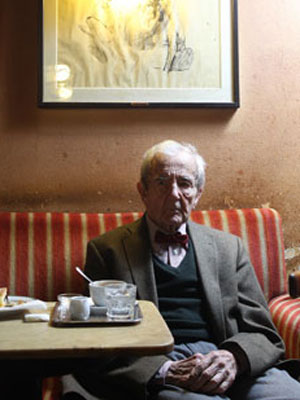
Obituary of a Viennese coffee house legend:
Leopold Hawelka, 1911-2011
“Look, what a pig, Jesus Christ, what does a nudist do in Hawelka’s?” sang Georg Danzer in 1975, in an intellectually rather modest, but commercially very efficient way: the song made him a star within two weeks. It would remain his only number one hit in Austria though.
However, together with Wolfgang Ambros’ Bob Dylan cover ”Da Hofer” (1972), Danzer’s simple-minded song triggered a veritable (Viennese) dialect wave in the Austro-Pop genre. Its lyrics obviously owe their impact to the staging of a transgression. A “streaker” is imagined here as he enters (ignorantly?) a true Viennese institution: the venerable Café Hawelka – “meeting place of artists, Buchtel bulwark and tourist attraction,” as the Viennese newspaper Der Standard aptly describes it.
The owner of the café, Leopold Hawelka, was born halfway between Vienna and Bohemia in Mistelbach, Lower Austria, in 1911. In 1936 he married Josefine (who also figures in Danzer’s song), and the couple opened their first café, “Alt-Wien” on Bäckerstrasse, before they took over their all-time favorite: a place of barely 100 square meters which exudes the charm of a slightly run-down bourgeois living room (the interior is supposedly by a student of Adolf Loos; the Hawelkas never had it replaced). In 1939 the café was closed for several years because of World War II, which both the café and its owners survived surprisingly well.
From the 1960s, the Austrian painters of Fantastic Realism (such as Ernst Fuchs or Friedensreich Hundertwasser) started hanging out in Café Hawelka, along with a number of literary figures like Heimito Doderer, Friedrich Torberg or HC Artmann, the actors Oskar Werner and Helmut Qualtinger, the conductor Nikolaus von Harnoncourt and other usual suspects. However, not even the wildest of them would have had the guts to commit acts such as those described by Danzer: exhibitionism in front of Mrs. Hawelak’s stern eyes. Not to forget her divine sweet yeast dumplings (Buchteln) which forced an armed truce even upon people who were performance artists by profession.
Thus ‘la’ Hawelka, in the 70 years of her marriage, ruled the social field the café had created like a soccer referee. Her husband Leopold watched the events on the ‘pitch’ from his regular place close to the bar. He was more like a linesman who gave his signals, but left the talking to his dear wife.
However, the “focus of the Viennese art scene” (Der Standard) suffered more recent losses than just Josefine’s death in 2005. Not least was a smoking ban which came into force in 2010 after Mr Hawelka had prevented the construction of a glass wall in his café to separate the non-smokers from the evildoers. Since then, you are only allowed to smiz in the winter garden. As a silent protest, the boss continued to put ashtrays on the tables indoors as well. But due to the loss of (legally smoking) customers, the Hawelka family had to give up another social institution: their weekly closing day on Tuesdays.
Yet the ageing process of the Hawelka hype had started even before the centenary of its legendary owner in April 2011. Generations of café patrons much younger than the founding father and mother preferred to escape to other coffee houses from the tourist crowds squeezing into Hawelka’s quasi-living room; they decided to bow to the dictatorship of the Viennese waiters’ proletariat elsewhere. Thus many artists – or at least, art students – since the 1980s would rather hang out in Kaffee Alt-Wien, the place abandoned by the Hawelkas in 1939: call it an irony of history.
Finally, on 29 December 2011, Leopold Hawelka, that silent rock in the tsunami of Starbucks & Co., passed away quietly surrounded by his family. A friend commented: “Nothing but losses this month: first Havel, and now even Hawelka.” However, like it or not, his café will stay. +
(c) Ruthner & LIDOVÉ NOVINY, 2012
> German version of this article (c) DEL.CLEM, 2012
PS. Another obituary in English (c) THE GUARDIAN, 2011


23 January 2012 at 18:18
I like this post, enjoyed this one regards for posting .