“River water music for diehards”
The Story of Dragoljub Milanović: a true Handke indeed.

“This is not a sermon, but (…) a story. A story to tell, if necessary, to a woodpile or an empty snail shell or even to myself alone, by the way not for the first time –”*
Peter Handke’s narrator, the self-appointed chronicler of Dragoljub Milanović’ Story, suffers from a strangely missionary pessimism that leads him to formulate unbearably beautiful sentences like the one quoted. And if no one listens to him, he is just going to talk to his “shoelace”, the “nutcracker”, or even a “worn-out doormat.”
‘Talk to the hand,” evil tongues of Americanized origin probably would tell him, but in Handke’s world Americans such as “William ‘Bill’ Clinton” (as he is disparagingly called) have a bad reputation anyway. On the other hand, the tragically good guys from the author’s notorious Yugoslav war diaries are back again: the Serbs as the epitome of “Balkan Apaches” (Richard Schubert), here embodied in a martyr, Dragoljub Milanović, former director of Serbian State TV (RTS).
In 2002, Milanović was sentenced by a Serbian court to ten years imprisonment for not having evacuated his co-workers during the NATO air raids on Belgrade in April 1999; he let them work instead. As a part of the international military intervention to end the violence of Serbian soldiers and paramilitary groups in Kosovo, a “smart bomb” destroyed the RTS building and killed sixteen employees, but left the environment intact:
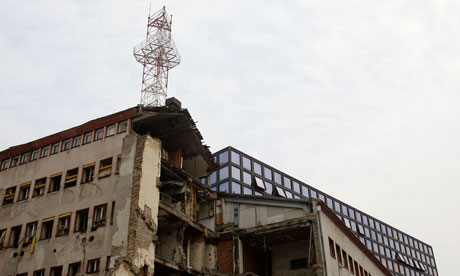
“During the impact of surgical bombing, or so, the air pressure, or something, threw them from the cutting tables in the station basements, or wherever, through the broken windows onto the tree which was almost bald then, and now the spring, between the green birch leaves, makes the other green bands waft through the air.”*
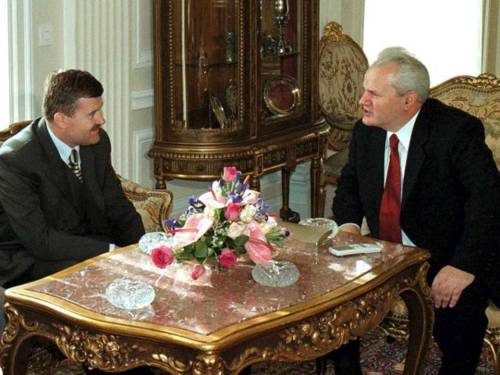
Thus, at first glance, this text seems to be again very handky indeed. But doesn’t the author increasingly feel some discomfort because of his ardent commitment to the more or less totalitarian rump-state of Slobodan Milošević, whose radical nationalism triggered the genocides in the former Yugoslavia, impeded the freedom of the media and hid the war crime suspect General Mladić for years? Can it be taken as a sign of a mental U-turn that Handke tells the true story of a Serb who was imprisoned by Serbs?
This hope evaporates quickly, since the narrator ultimately makes the international community liable for the punishment of Milanović: not himself nor Serb politics which might have looked for a scapegoat and found it in the – otherwise well-wired – TV director who has been serving his term ever since in Zabela near Požarevac. (Doesn´t that rather sound like a Post-Milošević power struggle?)
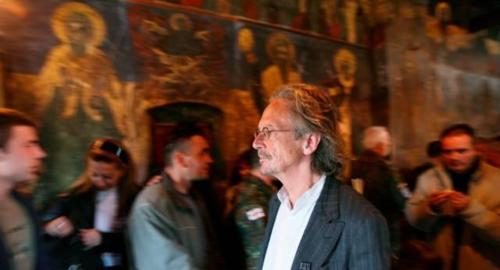
 However, the enthusiasm for hard evidence on the roadside, such as melancholic leaves and trashed tissues is typical of the Stifter-fan Handke. Taking care of social conditions, or even politics, however, is not really his thing. Thus a certain narrow-mindedness and little inconsistencies permeate the text. It remains unclear, for example, whether Milanović was sentenced to nine or ten years in prison. Similarly, the narrator persistently denies that the “image sequences” which were televised by Milanović in his day – “mainly on nature” and “the eternal Balkan folk dance” – could have been propaganda for the regime. No reason to bomb a TV station, Handke insists. He is pleased to tell that “something childlike” emanates from the prisoner whom he met.
Obviously Handke does not know how to search the internet, since otherwise the aesthete from Carinthia would have found indications there that his employees were forbidden from going home due to nationalistic motives. And that a second trial against him is in the making based on corruption charges: he is said to have collected almost half a million euro for the illegal allocation of public apartments. Another plot of political justice? For the author, however, the presumption of innocence becomes dogmatic certainty.
But, as is often the case in the literature, there are also passages where Handke’s story reveals itself. It becomes strangely clairvoyant towards the end of the text when the narrator says: “Yet the incarcerated might not exist. (…) What happened to him: He was invented. (…) The whole thing is nothing but a river watermusic for diehards, Yugo nostalgics, marginal groups, outsiders.”* A sudden sense of self-irony?
Not really, since humor has never been welcome in Handke’s exerted writing. So who is going to take the burden of this unsatisfying narration away from him in the future? In real life, Dragoljub Milanović still remains in Zabela with his story unresolved.
Peter Handke, Die Geschichte des Dragoljub Milanović,
37 pages / € 9, – Jung & Jung Publ., Salzburg and Vienna, 2011.
(c) Ruthner & Lidové noviny, 2011
Photos (c) Vesti, AP, EPA.
*) All translations mine.
 delirium clemens
30 October 2011 at 22:17
Here the link to the various reviews that this Handke’s book has received:
http://handke-yugo.blogspot.com/2011/08/handkes-politische-serben-klage.html
http://handke–revista-of-reviews.blogspot.com/2011/08/peter-handke-dragoljub-milanovic.html
to which I would have added the one above but for its nasty supposedly knowing self-righteous tone.
MICHAEL ROLOFF
>
> http://www.facebook.com/mike.roloff1?ref=name
>
Member Seattle Psychoanalytic Institute and Society
>
This LYNX will LEAP you to my HANDKE project sites and BLOGS
>
The Hubs, the Navel to Todos Handke!
>
http://handke-magazin.blogspot.com/2010/06/handke-magazine-is-over-arching-site.html