Pilgrimage to Hell
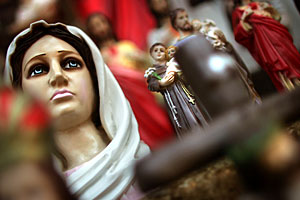
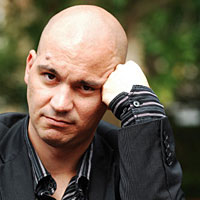
Thomas Glavinic’ new novel on a trip to Medjugorje, Bosnia-Hercegovina: Unterwegs im Namen des Herren [On the road in the name of the Lord].
Troubles begin early, when the first-person narrator boards “a not quite new coach which will bring me and the other pilgrims from Vienna to Medjugorje. There every day the mother of God appears, in whom I don’t believe unfortunately.” Predictable that for an undercover atheist writer and his photographer Ingo, this must become a living hell, even if he wants to get inspired by such environment.
The magic bus is swarmed with stereotypes: There are, for instance, the “hooded man”, the rustic “postal worker” (who actually is a computer person), a “midget with a silver cross around his neck,” a sex-addicted tennis instructor and “Intshu-Tchoona” who owes this American native nickname to his hair color. All are what they seem, and what they have in common is their destination – or is it rather their destiny?
The bus, and with it the new book by the Austrian author Thomas Glavinic, virtually go together to Europe’s largest ‘illegal’ site of pilgrimage in Bosnia-Herzegovina, whose St Mary apparitions have not been recognized by the Vatican so far. Here the literary road movie enters Hades: unsurprisingly, Medjugorje turns out to be a prison-like brain washing facility where the two protagonists are exposed to Christian fundamentalist propaganda. Hell is always the others, a finding that leads Glavinic’ protagonist inevitably into alcohol, nicotine, and other substance abuse.
However, the Madonna, who is called “Gospa” by the locals, does not show up. Only her photocopied messages remain, and the protagonist has to buy at least one gypseous statue of her in the giftshop, along with “a particularly gay Jesus”: “The guy at the cashier gives me a pious wish for the way. I nod to him and then make off since the atmosphere in the grounds increasingly depresses me” [all quotes taken from the novel, translation mine].
The signaled end of the unholy road is still not reached. The narrator falls ill with “the mother of all anginas” and has to be evacuated by his Croatian father to Split before Ingo loses it. But the chosen place of refuge on the Adriatic coast rapidly becomes another circle of hell: the two Austrians have to put up a manly resistance to some party animals (his father´s friend Ivica and his Croation gangster buddies) who offer a bit of Bunga-Bunga in their villa, shoot the neighbor´s goat in a plastered state of mind before they eventually escape through the back door.
Glavinic’s text comes across as a realistic hybrid between autobiography and fiction, documentary and fiction, as was already foreshadowed in previous books by the author. However, this blend is admittedly not a blessing, like the aforementioned coach from the Austrian backwoods, which smells of beer, sausages and stereotypes.
Cheap are not only the warmed-up Balkan clichés and the largely blunt language. Cheap is also the lighthanded bashing of the delusional worlds of pilgrims and crooks. The socio-psychological background for their beliefs, which would make a much more interesting subject, is simply left out. Glavinic remains a bad tourist, rants a lot and avoids any explanation of what exactly stands behind those yearnings for spiritual ‘belonging’, to which places like Medjugorje probably owe their appeal to a million of visitors every year.
Apart from its intended snotty-cool & cheap aesthetics, Glainic’ novel also misses the chance to tell the flabbergasting history of Medjugorje. Instead of betting his literary capital entirely on wannabe gonzo stunts à la Hunter S. Thompson (or rather the Austrian tabloid Die Krone?), Glavinic would have fared better had he combined them with the precise literary research methods of (eg.) Martin Pollak or Karl-Markus Gauss.
In addition to the crude prehistory of the apparition phenomena themselves – and the various conspiracy theories explaining them (like: the village priest – or the Yugoslav secret service – invented everything in 1981 to boost tourism in the Adriatic hinterlands), there are the ghastly stories of two warring pasts in the Medjugorje area: e.g. the massacres of civilians of different faith, carried out by Croatian militias in 1941 and 1992; the site of the Franciscan monastery, which was used as a testing ground for grenade launchers in the early 1990s; the critical bishop Peric, who dismissed the apparitions of the Holy Virgin and was therefore kidnapped and beaten by unlawful combattants in 1995; mafia-like shootouts trying to sort out disputes over distribution of incomes stemming from pilgrimage; and, and, and.
These are the true stories behind the shrine, which make Miss Mary and her peace messages appear to be a kind of collective working through trauma in a former war zone. To drill into this layer would have been more productive than ridiculing the gang of simpleminded losers from Vienna and Styria whose attempt to find meaning in life is organized by a cheap travel agency.
At least at the end, the narrator is straightforward when he has to admit that what he experiences a) seems to be “a banal midlife crisis” and b) that “the yearning for the divine” has not left him: “and exactly that I am becoming aware of: the existence of a tacit agreement with myself that I have not slammed the doors behind me.” Whether this suffices to make a good piece of literature is another question.
Thomas Glavinic, Unterwegs im Namen des Herrn. € 18,40 / 208 pages. Munich 2011, C. Hanser Publ.
German original version of this article © DER STANDARD, 2011
Factfinding: Medjugorje
 delirium clemens
1 October 2011 at 13:56
Blogging about…
[…]I really don’t ordinarily advise other web sites but I’ll break my trend for this[…]…
8 October 2011 at 00:21
It’s really great that people are sahrnig this information.
8 October 2011 at 07:18
Yeah, that’s the tckiet, sir or ma’am
11 October 2011 at 07:54
casino bonusi
Hey, can I use your entry on my blog with a linkback?