“Srebrenica Health Spa”
The Unbearable Lightness of Being Dead
There are many crime scenes where the idea of Europe was murdered in the “short” 20th century. One of them certainly is Srebrenica in eastern Bosnia, the place where the largest massacre after the Second World War executed by military personnel took its course.
We still have the TV images in our heads of how in July 1995 the invading Bosnian-Serb General Ratko Mladić (finally arrested in 2011) reassured the scared locals and refugees of his good intentions in a grumpy fatherly way. Then his soldiers started dividing the exhausted Muslims who were crammed into the disused factories in the suburb of Potočari into two groups. A special ‘selection’ took place for the first time again after Auschwitz: under the eyes of Dutch UN soldiers, women, children and the elderly were separated from the men who were driven into the nearby villages and forests and shot, more than 8,000, from teenagers to senior citizens (following a perverse patriarchal logic that women do not „count“: they are easier to control since you can force them more easily, rape them, and you don´t have to fear revenge from them – so no need to waste your bullets).
That’s Srebrenica where in these bright summer days of 2011 again 613 corpses identified by international forensics in the recent months are buried. And where 6,000 living people are attending a march to commemorate those who tried to escape through the woods 16 years ago. An eerie hike at 30 degrees Celsius, matching the temperatures in 1995.
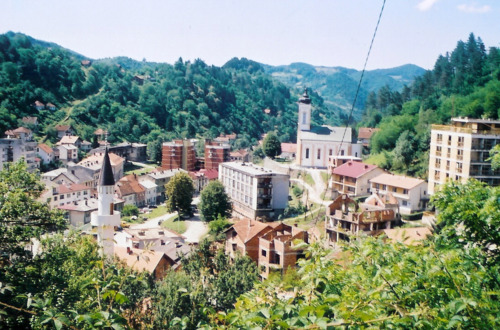
However, what makes the horrors of Srebrenica crawl so subtly under your skin is the fact that it actually could be a nice small town in a beautiful landscape. It could be a sleepy summer resort in southern Lower Austria or in the Tatras – if there weren´t still visible war damage, the ghost houses in the surroundings, the huge cemetery in Potočari, the factory buildings and UN quarters, where at the time a Dutch blue helmet scribbled his truly philanthropic graffito: “Bosnian Girl: No Teeth … Moustache … Smells Like Shit.”
Srebrenica historically has had a small success story as a mining town. In late Yugoslav times, it was just about to develop its hot springs and turn itself into a spa resort when, with the Bosnian War 1992-95, the unthinkable finally happened. Since then Srebrenica has become a European pilgrimage site of genocide, demonstrating what nationalism could – and can – cause basically everywhere on the Continent, not only in Eastern Europe, but also in Belgium, for instance, the Basque country, or Ireland. Yet one can hope the Srebrenica has opened the eyes of the many die-hards, at least for a while.
For whoever comes here, arrives in a huge open-air documentary of trauma, its effects and working-through strategies. People who want to live in patchwork families where the men (and often not only they) are not simply gone, but murdered. And if you buy the DVDs and books on sale everywhere in town, you will soon meet the people in real life whom you have seen on screen just before.
The souvenir seller at the cemetery, for example, who says she has lost her husband and both of their sons: the forensics discovered one of the two, but they cannot tell her which exactly. Or a farming couple whom the Austrian NGO “Farmers helping farmers“ assists: they live in a ghost hamlet nearby and got married quickly in order to get at least a little bit of family back. Or the former UN soldier Rob Zomer: one of the few who return to their place of shame in order to make himself useful to the community.
It is rather disturbing when you realize that Srebrenica today belongs to the Serbian part of Bosnia-Hercegovina, the so-called Republika Srpska. Thus the “ethnic cleansing” was actually reaffirmed in the 1995 Peace Treaty of Dayton so to speak. And if the local farmers go to the weekly market in one of the surrounding Serb villages, they have a good chance of meeting one of the men who pulled the trigger at the time, or at least still celebrate Mladić as their true all-time hero. “We are sheep who are supposed to live among wolves,” says one female survivor in one of the numerous TV documentaries on Srebrenica.
Trying to forget the trauma or remembering it – what is more helpful? The fact that Nordic Organic Food opened a factory for “Bio” nutrition right across the cemetery seems a bit tasteless; at least it means jobs. There are also plans to rebuild the spa facilities. But who will come for a wellness weekend to “Srebrenica Hot Springs” – or is it rather the horror of Potočari, which attracts potential visitors?
But who are we to judge? Imagine your neighbors from the surrounding areas have joined forces and most of the men in your village, in your family got killed and your houses burned down. Would you return to this place – and if you had no other choice than that, what would you do? Srebrenica could be anywhere.
(c) Ruthner & Lidové noviny, 2011 > GERMAN VERSION
 delirium clemens
3 September 2011 at 07:06
[…] > other postings on Srebrenica Share this:FacebookEmailPrintLike this:LikeBe the first to like this post. […]