The Medjugorje myth is turning 30
Visit to an illicit place of pilgrimage
When you come to Bosnia, you can read the magical name Medjugorje on hyper-modern coaches on their way through the bumpy streets of Sarajevo, bringing mostly elderly people to the place of their destination. And if you still were so naive to believe that true religion and two-fisted business are mutually exclusive, you are taught a lesson now: the money changers have long since returned to the (golden) temple, believe it or not.
The recipe for success was quite simple: Take a godforsaken backwater place in the Balkans just behind the coast. “Medjugorje” in English roughly translates into “between the mountains” – where the seven dwarves dwell, as readers of the Grimm Bros. might feel obliged to add. This is not entirely wrong, since Medjugorje, Hercegovina, has been the setting of one of Europe’s most popular modern folk tales: here on 24 June 1981 the Mother of God appeared to some local kids in order to tell them some “secrets”. Then hell broke loose in the Adriatic hinterland. Medjugorje has probably become the largest spontaneous place of pilgrimage in Europe in times of Christian recession.
From the perspective of academic parapsychology, the “ESP” messages the Holy Virgin left are pretty average, comparable to those that pop up at séances, for instance. They mean everything and nothing, when they speak of (inner) peace, love and that you should join the band of the faithful. More illuminating are the last words of the apparition, with which it said goodbye to its visionary Mirjana Dragićević on Christmas Day 1984: “She told me that she had accomplished what she had used me for. She told me that now, I was supposed to be aware enough of who I am and that I (…) should return to the normal daily life like other girls of my age.”
Life in Medjugorje, however, has been anything but normal since. Ms Maria logs on to other media – and her messages are carefully archived on the Internet. The “Queen of Peace” is even approached through the methods of empirical social research. The aged Father Janko, for instance, has launched a questionnaire with which the visionaries can help creating a kind of criminal profile of the heavenly intruder. From the data collected we learn that the phenomenon is female, 18-20 years old, 160 cm tall, 60 kg, and that you can ” see the neck, but nothing of her breasts.”
Even family members of the local priest claimed that he had made it all up and manipulated the visionary children involved (whose proud hockey parents obviously had nothing against it). There are also conspiracy theories claiming that the Yugoslav secret service, confronted with the lack of living Communist saints after the death of Tito in 1980, created the Medjugorje myth in order to stimulate tourism.
An argument against the latter assumption is that in October 1981 the parish priest Jozo Zovko was sentenced to three and a half years of forced labor for alleged involvement in a nationalist conspiracy. After some international lobbying including Amnesty International, the penalty was reduced by the Yugoslav federal court and the priest released from prison in 1983. Is this the subject matter martyrs are made of?
Despite its generosity during the last decades when it came to beatifications, the Vatican however remains skeptical, along with the local diocese. Several official fact-finding committees found that the symptoms were most likely not of supernatural origin. Disciplinary action was also taken against local clerics involved and doubts raised about their pastoral skills. Behind this, a power struggle becomes visible about who has the say in spiritual matters. In 2006, the local Bishop Ratko Perić stated in a sermon that in Medjugorje “something like a schism” exists.
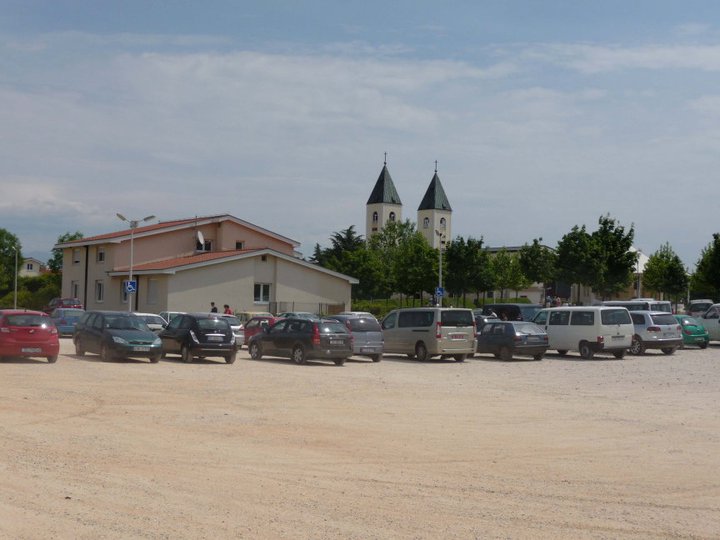
The pilgrims don´t really mind. Up to a million of them annually visit the small town regularly inhabited by 4300 souls. With its colorful guest houses, pizzerias and souvenir shops, the place rather has the flair of a Croatian coastal resort (without sea). Everyone who has crossed the dusty desert of the central parking is faced with a Babylonian chaos of pensioners, wheelchairs, coaches, nuns on bicycles, and an overpopulation of taxi drivers and statuettes of St Mary. They all flock to St. James’ Church, which radiates the sober charm of a renovated parish in a working class district of Vienna, or the place where the apparitions allegedly took place. Those who cannot walk are being pushed. Amidst this busy Catholicism you can even spot the business sign of an Irish real estate agent.
The sacred rush hours did not even stop during the Yugoslav wars of the 1990s. From that time, however, Medjugorje has kept some other ghosts. In July 1992 the town was the starting point of “ethnic cleansing” that led, among other things, to the destruction of the Serbian Orthodox monastery Žitomislići. From 1993, local Croatian warlords ran a camp in the area where Muslim and Serbian prisoners were tortured and murdered. In addition, a nearby lot of the Franciscan Order was used as a firing range for mortars.
The Bosnian war seemed to be the ideal background for retaliation: in 1995 Bishop Perić, one of the leading apparition-critics, was kidnapped and beaten by Croatian militia men; he was only released after the intervention of the UN and mayor of Mostar. No wonder that sharp tongues insinuate that the war was used by competing clans to fight out their positions on the market of sacred resources.
But the roots of violence are even older than this. In 1941 members of the Croatian fascist Ustasha militias committed a massacre on 559 Serb civilians nearby. Later, in communist Yugoslavia, the cave with the dead bodies was sealed with a concrete lid; only in 1989 were they exhumed and buried in neighboring Čapljina. Sadly, they don’t seem to be the material either saints are made of in our days.
From the perspective of modern trauma research, however, all these dead could actually lie at the base of the messages of peace sent out by the “apparition” in the 1980s, as a sort of cathartic ‘working-through’ mechanism of collective memory in the violence-torn region. Medjugorje thus is more a case for cultural studies than for theologians and parapsychologists: a prime example of the power of narrative under historical circumstances, a sort of ‘infection’ by faith that cultural stories produce when they become myths.
Nevertheless, it would be great if the message of peace arrived in the region itself one day – no matter where it came from. A visit to the nearby city of Mostar shows how difficult this is: too much entrenched have the political positions of radical Muslims and Croats become. The historic bridge is rebuilt; in the urban area, however, segregation is preferred over cooperation. There are other, nationalistic narratives that prevent the latter from happening – and apparently people believe in them more than in apparitions.
*
© Ruthner & Lidové noviny, 2011
>> GERMAN original version
 delirium clemens
19 June 2011 at 05:09
Now thats stuble! Great to hear from you.
24 June 2011 at 02:05
I’m impesrsed! You’ve managed the almost impossible.
14 September 2011 at 21:04
[…] Factfinding: Medjugorje Share this:FacebookEmailPrintLike this:LikeBe the first to like this post. […]
24 July 2013 at 16:13
Hello there! This post
could not be written any better! Reading through this post reminds
me of my old room mate! He always kept talking about
this. I will forward this page to him. Pretty sure he
will have a good read. Thanks for sharing!