Belgium: a never-ending story?
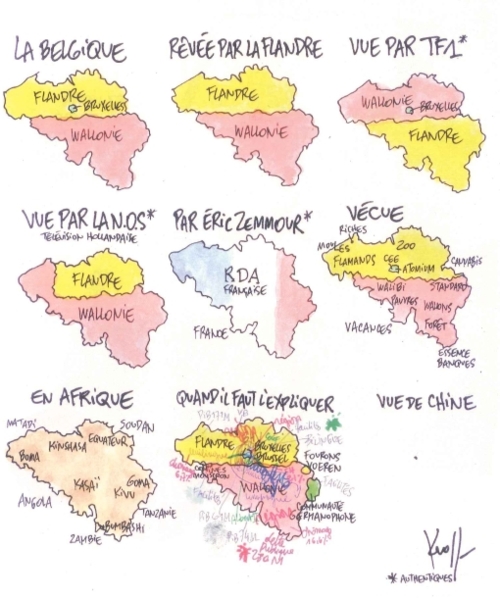
Is it just political shadow boxing or has the last act of the “Flemish vs Walloon” tragicomedy already begun? However, Belgium is not Central Europe – or is it? Some food for thought for nationalists and Europeans.
(>> switch to German version)
Belgium is like the unloved rich aunt in the nursing home, whose death is expected with impatience by her would-be heirs. However, auntie has been surviving quite a few serious illnesses throughout the years – only to be carried away by a simple flu one day. Is it so with Belgium this time – now that the country holds the dubious European record of not having a working new government more than a year after elections were held in 2010 after another year of political crisis?
In the international press you could always read a lot of nonsense about the cozy little country famous for it gourmet pleasures. In media imagination, this is the venue where the Flemish, who speak “Flemish” of course, fight the “Walloons“ and bring the patchwork nation close to the brink of civil war. Little is known about the deeper reasons for the conflict between Dutch- and French-speaking Belgians (since most Francophones in Brusssel are, strictly speaking, not “Walloons“, but linguistically converted Flemings). On paper, Brussels is the only bilingual region. The other two entities, Flanders and Wallonia, are (except for the German-speaking “East Cantons” Eupen and Sankt Vith) monolingual by law. Thus the whole complex situation is less a “language war” than a serious conflict about the question of who is the real boss in the common federal household in Brussels.
After the founding of the Belgian state in 1830, the French-speaking industrial elites (among them many Flemish!) exercised their cultural, linguistic and economic hegemony over Flanders, which was mainly agricultural at the time. Today most of the Walloon (and Limburg) coal mines and blast furnaces are shut down. The Flemings have effectively fought for their political and cultural equality and pay with their successful “new industries” for the debts and pensions of their former masters. Meanwhile their historical capital Brussels is 85% French-speaking, which leads to distortions in local politics and election laws. The accelerated federalization of the state since the 1960s has led to a sort of “home rule” for the Flemish and Walloon entities. On the other hand, this has not only reduced the opportunities for mutual aggression, but also contributed to further alienation and desolidarization between the linguistic communities.
An unpleasant political psychology which is in some respects reminiscent of the Habsburg monarchy or even Yugoslavia. It provides the busy (and successful) Flemish nationalists from the political left to the extreme-right with free ammunition over and over again. In the last twenty years, however, the problems of the Flemish-Francophone coexistence within the Belgian state have mostly been used for political rhetoric only: little storms in the parliamentary water-glass, which mostly ended with handshakes, because compromise culture has always been very dear to Belgians. On the other hand, the need for a new state reform, which would approach the complicated cohabitation particularly in the Brussels suburbs in a more satisfactory way, has become more and more urgent.
When I lived in Antwerp in the 1990s, the federal government initially seemed doomed. The Belgian flag was hoisted only on bank holidays and on the occasion of soccer games. Those who would fly the tricolor longer had to reckon with angry phone calls from their neighbors. Then the government of the bunny-toothed political model pupil Guy Verhofstadt knew how to make people forget these disputes. Belgium celebrated something like a renaissance as a very liberal state with avant-garde legislature on gay marriage and the international prosecution of war criminals.
But even then, the Flemish politician Louis Tobback, a seasoned veteran socialist, came up with a master plan for the Belgian division , which he called “Brussels DC”. Its central concept was that the Flemings, as a price for their independence, should give up the Belgian (and their) capital Brussels – a previously unthinkable, even blasphemous step for right- and left-wing nationalists alike. Tobback´s plan entailed passing the European capital on to EU administration which would run it as a quasi city-state.
After that half-happy interlude with Verhofstadt, the Belgian political crisis has continued to grow like a tumor since 2007. Plus there are some unlucky human resources problems with the main dramatis personae of this political tragicomedy. First, there is no evident successor to the throne in sight after the reign of King Albert II, a person to whom all Belgians could relate. Secondly, the country´s successful crisis manager Herman Van Rompuy was ‘donated’ to the European Union in 2009. Thirdly, the mousey Yves Leterme, who is still the provisional head of government, doesn’t seem to be up to the task to reunify the country again, along with, fourthly, Bart De Wever standing in the waiting room of national politics: the first charismatic Flemish separatist ever who seems to be acceptable to the broad electorate far beyond extreme-rightists.
Thus, a further development of the Tobback scenario is thinkable in case Belgium continues to implode. As a first step, the six (!) democratically elected regional parliaments of Flanders, Wallonia and Brussels and the non-congruent three language communities could initiate a referendum on the future of Belgium, probably leading to
→ Flanders declaring independence (capital city: Antwerp or Ghent); less likely and only favored by some intellectuals is a “Great-Dutch” solution, i.e. the affiliation of Flanders with the large neighboring country in the North, which a Flemish majority would not ‘buy’ due to their historical big-brother complex.
→ Wallonia declaring independence as well, with its administrative center, pretty sleepy Namur, or Liège, its historic center, as capital. Because of economic and identity issues, however, an affiliation with France would be much more likely, meaning that the Grande Nation would expand to the city gates of Brussels again after 200 years. However, due to the financial problems of the region this would be a poisoned chalice, and it is hard to say whether Sarkozy & Co. would take it or leave it.
→ Also tricky is the case of the small German community in East Belgium, which with 65,000 residents and three minister posts may count for the most protected minority in Europe, even ahead of the South Tyrolese. Joining the Federal Republic of Germany out of necessity would make them lose all these privileges; therefore another likely scenario is their accession to Luxemburg, which would thus increase its territory by almost 40 percent.
Indeed a complex, delicate and slightly absurd scenario from a European perspective. However, it could easily come true, as the examples of Slovakia and Montenegro have illustrated in the recent past. And Europe would have difficulty denying the Flemings what was conceded to the Slovaks and Kosovars in free-handed spin-offs. In comparison to those two, the division of the Habsburg monarchy after the First World War was quite democratic, i.e. at least partially sanctioned by referenda.
Moreover, with the hasty declaration of Kosovo´s independence in 2008, Europe has created a dangerous role model, as the example of the Georgian-Russian war about the dissident provinces of Abachasia and South Ossetia showed in the very same year. So nobody could/should disagree with a democratically buffered divorce process in Belgium – and if a majority votes for the preservation of the common state, this would, as the example of the referenda in Quebec shows, even stabilize the country, at least for a while.
However, the deep structure of that global desire for “independence” is the unsatisfying fact that since the 19th century, our key collective identites can hardly be imagined outside of nation states. The emergency solution of 1830 – “Belgium” as the Kingdom of unlimited impossibilities for two little Catholic leftovers in Northwestern Europe – is a remnant and reminder of a past before ethnolinguistic nation building came into fashion as the prevailing political narrative.
Alternative approaches are urgently needed – until then, democratically sanctioned secession is likely to be the lesser evil than political violence, as long as the EU roof above it remains waterproof. Not to mention that several other regions are aspiring nation states: the Scots, Welsh, Catalans, Basques, Kurds, the Bosnian Serbs – who else? They all look at Brussels: the Belgian and European capital.
(c) Ruthner, 2010-11
(unpublished otherwise; some intelligent newspapers missed their chance here:)
CLICK HERE for the German version of the text.
 delirium clemens
29 June 2013 at 11:48
Wow, this paragraph is pleasant, my sister is analyzing these things, thus I am going to let know her.
1 August 2013 at 08:16
Magnificent items from you, man. I’ve bear in mind your stuff previous to and you are just too excellent. I really like what you have received right here, certainly like what you’re stating and the
way through which you assert it. You’re making it enjoyable and you still take care of to keep it smart. I cant wait to learn much more from you. This is really a wonderful web site.
24 February 2014 at 14:27
Can I simply say what a relief to find somebody that actually understands what they’re discussing over the internet.
You definitely understand how to bring an issue
to light and make it important. A lot more people have to
check this out and understand this side of the story. I was surprised you aren’t more popular given that you
certainly possess the gift.