Going for a Smoke: Letter from Sarajevo
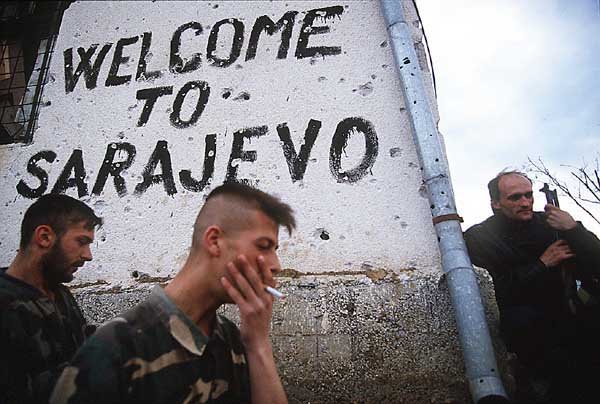
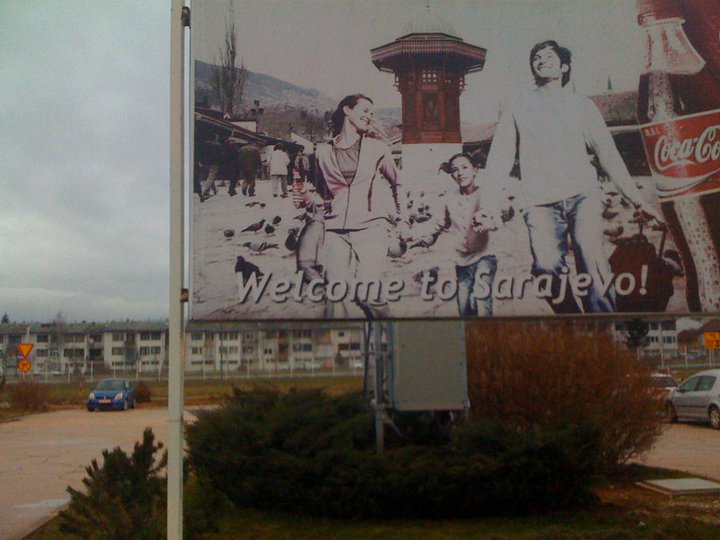
Welcome to Sarajevo: On Ron Haviv’s famous war photo from 1994 you can see men wearing uniforms in front of a ruined house. A fire and smoke break. Nowadays, a poster outside Sarajevo airport carries the same title, but it shows a happy family, the Sebilj Fountain in the old part of town – and a bottle of Coke: icon of a lifestyle change in the 15 years after the war?
Sarajevo has become a city like many others in Central Europe. When you walk through the main street still called Maršala Tita (it used to be Kaiser-Franz-Josef-Strasse long time ago), it could be in Poland or Hungary. Maybe Innsbruck because of the mountain range? Likely not Prague, since that place is too duffed, but perhaps Brno or Ostrava, because of the narrow river. There are restored buildings from the Habsburg period (1878-1918), fancy shopping centers, a few run down buildings that smell familiarly of mould and cat pee, and another mountain range of communal housing. (In between second-hand street cars from Vienna, Prague and Amsterdam going all along the East-West axis of the stretched city, together with the biggest collection of vintage Volkswagens I have ever seen.) The few still existing ruins of war are professionally disguised as construction sites. However, the ubiquitous bullet holes which I like to call house acne are also available in Budapest.
So, in terms of architecture, Sarajevo is a fascinating cocktail of Central Europe, the country with the forbidden name (Yugoslavia), a pinch of globalization, and: Istanbul. The only discernible difference from other cities in the region is the many mosques and the old bazaar, the Baščaršija. A little Semi-Orient, at least in the perception of many Austrian, Hungarian or German authors around 1900. Today this is a good place to teach self-appointed Islam scholars, who warn of the dangers of that religion, a little lesson.
In the streets you can see the strange conglomerate of lifestyles, which is also characteristic of Sarajevo: young men who drink only fruit juice in the evening, and those who get hammered with liquor; and then the eternal game of headscarves vs. mini skirts of gynecological length. I don´t intend to take the overused buzz word “hybridity” in my mouth. Yet in Sarajevo, all these silent dress codes co-exist next to each other, and as peacefully, it seems, as in Vienna or Berlin too. A harsh Slavic welcome is often followed by a lot of cordiality and humor, and then wild smoking. There´s wild partying in the city as well. One quickly feels in good hands and wonders, given all the wonderfully interesting and warm-hearted people, who actually fought that atrocious war.
Walking through the busy light-heartedness hanging over Sarajevo, its curse is simply unimaginable: that in the 1,425 days of siege in 1992-95, about 10,000 people were killed, including approximately 1,500 children. Despite the prevailing spring mood you’re in a post-war society in which desired normality and old trauma live closely together. EU and Bosnian sources estimate that 20,000 – 50,000 of all Bosnian-Herzegovinian women were raped during the war. And if you drive through the Serb surroundings of Sarajevo, you stand a good chance to see the men working in the fields, who at the time shelled the city, and maybe more. Some of them even wear their old military jackets. But not only for them a visit to a therapy group seems to be rather uncool. The common concept is to carry on and repress the past.
However, the high price for the shaky Dayton Peace Treaty in 1995 was not only paid in human lives, but also politically. In addition to the disasters of war and an economy that is on the drip, it is especially the labyrinthine administrative structures that prove to be very difficult and inefficient for the country. A patchwork of small cantons and two states in one – the Federation and the Republika Srpska – plus a government crisis are millstones on the road to normality. But honestly, this is not so different in Belgium.
What you can´t ignore in Bosnia-Hercegovina are the radicals on all three sides – Muslims, Serbs, Croats – who continue to attract unpleasant attention. They also exist in the EU countries indeed, but they can do much more harm here: with fundamentalism – no matter if this is nationalism or Islamism – or any sort of revisionism. Recently, a problematic book on the notorious Serbian massacre in 1995 was promoted at the Leipzig Book Fair with posters ballyhooing: “The Truth About Srebrenica!” The country is full of such negligent or deliberate appeals to frustration, self-victimization, comparative suffering, genocide envy and barely repressed violence.
However, the situation of the country is highly normalized nowadays and far from what a Bosnian colleague said to me in 2003: “Do we need to kill each other again in order not to be forgotten?” Still, when Europe has its own economic crisis under control again, it will have to turn back to the Western Balkans. Some of my students fear the possibility of new violence, especially since they escaped the last one as children. Thus, it will be this region where the future of the continent and the credibility of its Union will be determined, not only in Brussels.
Only the quick EU accession of Croatia, Serbia, Bosnia-Herzegovina, Montenegro, Macedonia and Kosovo would help to maintain a long-term peace and strengthen postwar societies in the region. Open Schengen borders would make the ethnic separatism of minorities evaporate in the long run. And ironically, an EU accession would restore structures for which many people here nostalgically yearn: the good ol´ days of Yugoslavia. Europe should not try to copy that state; on the other hand, the idea of a shared continent could recover here in the culturally hybrid streets of Sarajevo where it was shot twice: in 1914 and in 1992.
Sarajevo: future capital of the 21st century?
*
(c) by Clemens Ruthner & LIDOVÉ NOVINY, 2011
LINKS >> German original text >> Czech version (transl. Lucie Zídková)


13 April 2011 at 02:29
Welcome To Sarajevo…
[…] at least in the perception of many Austrian, Hungarian or German authors around […]…
28 April 2011 at 05:28
I just wanted to inform you about how much we appreciate every little thing you’ve contributed to help improve lives of folks in this subject material. Through your articles, we’ve gone out of just a newbie to an expert in the area. It is truly a gratitude to your efforts. Thanks
28 April 2011 at 07:08
Interesting info as per usual, much appreciated. I do hope this kind of thing gets more attention.